Saturday, May 06, 2006

War, Peace, Patriots, & Citizens


MUST READ: American Patriot
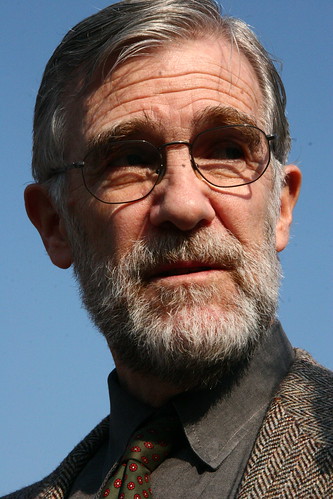
David Rolland interviews Former U.N. weapons inspector Scott Ritter who takes aim at Bush, Clinton, the CIA, Cindy Sheehan--and you.

Ritter, a former Marine officer, adviser to Gen. Norman Schwarzkopf during Gulf War I, U.N. weapons inspector and long-time critic of Bush's Iraq War, has some cogent thoughts on subjects including American citizenship, the "Peace Movement," and the role of the military in our country.

I strongly urge everyone to read the article here.
Photo credit: Former U.N. weapons inspector Scott Ritter on Jan. 20, 2006 at a symposium for the International Commission of Inquiry on crimes against humanity committed by the Bush administration. (Photo By Photo by Spencer Platt/Getty Images)

Also recommended:

Friday, May 05, 2006

In the Foggo of War


Poker, Hookers and Spooks
By Maureen Dowd
The New York Times
So much news was popping out all over Washington yesterday, it was hard to decide which way to look.

I felt I had no choice but to go with Dusty Foggo, Top Spook.

There was also the story of a Kennedy cover-up, moonlight car accident and drug abuse. Been there, done that.

And the story of a top U.S. official stuck in the cold war taunting the Russian bear. Been there, done that.

And the story of a delusional secretary of defense being confronted in public for lying about an unpopular war producing a steady stream of body bags. Been there, done that.

But Dusty Foggo? That's a name for a spy that tops Valerie Plame, or even Valerie Flame.

And when you add Dusty to Duke, you've really got something. Dusty was handpicked by Porter Goss in late 2004 to be the No. 3 C.I.A. official, astonishing many agency veterans, according to Newsweek.

Dusty turns out to be a friend of a defense contractor implicated in the federal corruption investigation of the imprisoned Randy "Duke" Cunningham, a former G.O.P. congressman. The contractor, Brent Wilkes, is now entangled in allegations of louche and lewd behavior involving limos, hookers, a poker player with a missing digit from the C.I.A. nicknamed "Nine Fingers," and Watergate hospitality suites where more was offered than just Scotch and pretzels.

Been to the Watergate, haven't done that.

Yesterday, Porter Goss lost the job he never should have had in the first place. After John Negroponte gave Mr. Goss the ax, W. went biking in Beltsville, Md.

When spooks get spiked, W. spins the spokes.

The C.I.A. missed 9/11 and W.M.D., so you'd think President Bush would want a superstar in the job. Instead, he put in a Cheney lackey whose first move was to warn agency employees to get in line, that their job was to "support the administration and its policies." Mr. Goss's last move was to fire a top C.I.A. officer, Mary McCarthy, who was accused of, but denied, leaking the secret C.I.A. prisons story.

Mr. Goss got the job even though the 9/11 commissioners had declared that Congressional oversight of intelligence was "dysfunctional" at a time he ran the House intelligence panel.

He got the job even though he tried to help the vice president suffocate the 9/11 commission. At the C.I.A., he relied on so many cronies, he made Brownie look professional.

The benign but still disturbing explanation for his abrupt termination — given all the home videos that Qaeda terrorists are brazenly sending out — is that he and John "10 Fingers" Negroponte were fighting over access to W., like teenage girls over the prom king. (Wasn't Mr. Negroponte's position created to quell turf battles?)

Even conservatives found yesterday's chain of events suspicious. Bill Kristol said on Fox News, "I think there were either serious disputes or some internal problem at the agency or some scandal conceivably involving an associate of Goss's."

The president is supposed to announce Mr. Goss's successor on Monday. It's clear that the White House is again making policy on the fly.

With all these loony threads, conspiracy theorists are having fun weaving dime-novel scenarios.

After all, Ms. McCarthy, the C.I.A. officer ousted by Porter Goss, worked in the agency's inspector general's office. That office — charged with investigating transgressions by C.I.A. employees, like questionable dealings with defense contractors in hotel rooms, with poker and perhaps even pajama games — is now examining Mr. Foggo's dealings with Mr. Wilkes.

Ms. McCarthy was known to be a supporter of John Kerry, not one of the Bush loyalists who could be counted on to see no evil.

She has been labeled a traitor by the right, just as Ray McGovern, a former C.I.A. analyst who challenges Rummy's veracity, is being Swift-boated as a nut case and partisan.

Mr. McGovern and other disgruntled retired spooks say the C.I.A. has been misused, abused and marginalized by the Bush hawks. Rummy even formed his own C.I.A. within the Pentagon to get the prewar intelligence that he and Dick "Trigger Finger" Cheney wanted to hear.

Are disgusted retired C.I.A. analysts colluding with disgusted retired generals to wreak revenge on Rummy, who ran roughshod over them all? Is W.'s dad sending him a message? Mr. McGovern, oddly enough, was a C.I.A. briefer for Poppy. Or are those just wild Potomac conspiracy theories?

Weirdest of all, Patrick Kennedy's car accident was just a block or so from Mr. Goss's Capitol Hill town house. Coincidence?

Hard to tell, in the Foggo of war.

Photo credit: Maureen Dowd. (Fred R. Conrad/The New York Times)

A Taste of His Own Medicine


By John Tierney
The New York Times
Now that Rush Limbaugh has managed to keep himself out of prison, the punishment he once advocated for drug abusers, let me suggest a new cause for him: speaking out for people who can handle their OxyContin.

Like Limbaugh, Richard Paey suffers from back pain, which in his case is so severe that he's confined to a wheelchair. Also like Limbaugh, he was accused of illegally obtaining large quantities of painkillers. Although there was no evidence that either man sold drugs illegally, the authorities in Florida zealously pursued each of them for years.

Unlike Limbaugh, Paey went to prison. Now 47 years old, he's serving the third year of a 25-year term. His wife told me that when he heard how Limbaugh settled his case last week — by agreeing to pay $30,000 and submit to drug tests — Paey offered a simple explanation: "The wealthy and influential go to rehab, while the poor and powerless go to prison."

He has a point, although I don't think that's the crucial distinction between the cases. Paey stood up for his belief that patients in pain should be able to get the medicine they need. Limbaugh so far hasn't stood up for any consistent principle except his right to stay out of jail.

He has portrayed himself as the victim of a politically opportunistic prosecutor determined to bag a high-profile trophy, which is probably true. But that's standard operating procedure in the drug war supported by Limbaugh and his fellow conservatives.

Drug agents and prosecutors are desperate for headlines because they have so little else to show for their work. The drug war costs $35 billion per year and has yet to demonstrate any clear long-term benefits — precisely the kind of government boondoggle that conservatives like Limbaugh ought to view skeptically.

Yet conservatives go on giving more money and more power to the drug cops. When critics complained about threats to civil liberties in the Patriot Act, President Bush defended it by noting that the government was already using some of these powers against drug dealers. Why worry about snooping on foreign terrorists when we've already been doing it to Americans?

Limbaugh objected when prosecutors, unable to come up with enough evidence against him, demanded to be allowed to go through his medical records in the hope of finding something.

He managed to stop them in court, but other defendants can't afford long legal battles to protect their privacy.

Drug agents and prosecutors go on fishing expeditions to seize doctors' records and force pharmacists to divulge what they're selling to whom. With the help of new federal funds, states are compiling databases of the prescriptions being filled at pharmacies. Once their trolling finds something they deem suspicious, the authorities can threaten doctors, pharmacists and patients with financially crippling investigations and long jail sentences unless they cooperate by testifying against others or copping a plea.

Paey was the rare patient who refused to turn on his doctor or plead guilty to a problem he didn't have. He insisted that he'd been taking large quantities of painkillers because he needed them. He wanted to protect his own right to keep taking them, and others' rights as well.

"They say I was stubborn," he told me last year. "I consider it a matter of principle."

Limbaugh got off partly because he could afford the legal bills (which he says ran into millions of dollars) and partly because he cooperated with prosecutors. He confessed to being an addict, went into rehab and swore to remain clean.

Perhaps he really was one of the small minority of pain patients who hurt themselves by compulsively using drugs like OxyContin for emotional, not physical, relief. But most pain patients can become physically dependent on large doses of opioids without being what doctors consider an addict. They take the drugs not to escape reality, but to function normally.

Even if Limbaugh believes that drugs like OxyContin are a menace to himself, he ought to recognize that most patients are in Richard Paey's category. Their problem isn't abusing painkillers, but finding doctors to prescribe enough of them. And that gets harder every year because of the drug war promoted by conservatives like Limbaugh.

It has been said that a liberal is a conservative who's been arrested. I wouldn't wish such a conversion on Limbaugh. But a two-year investigation by drug prosecutors should be enough to turn a conservative into a libertarian.

Photo credit: John Tierney (Fred R. Conrad/The New York Times)

Court Dubious on Libby's Document Request


Charles Lane, The Washington Post:
" A federal judge dealt a setback to I. Lewis 'Scooter' Libby's defense in the CIA leak case yesterday, telling the former vice presidential aide's attorneys that he is likely to deny their request for a vast trove of government documents." Read more.
Photo credit: I. Lewis 'Scooter' Libby (By J. Scott Applewhite -- Associated Press Photo)

Plame Leak Investigation Source Materials:

Perspectives:

From The US Department of Shame


  • Senate Defies Bush on Spending
    The Senate ignored President Bush's veto threat yesterday and easily passed a $109 billion emergency spending bill for war and hurricane recovery costs that also brimmed with favors for farmers, the fishing industry, and the states of Hawaii and Rhode Island.
  • Cleaning Up Congress
    The so-called lobbying reform bill that just passed only adds fuel to the fight for real change on Capitol Hill.
  • Progressive Federalism Under Attack
    All across the board, Republicans, now that they control all three branches of federal government, have jettisoned their former ideology of "state's rights." They've reverted to what some of us expected all along was their true philosophy—seizing power wherever they can and holding on to it for its own sake. Progressives, in retreat at the national level, have responded effectively by embracing local battles.
  • George And Mahmoud Play Chicken
    Two crazy messianic leaders face off. Does anyone think this is really about some centrifuges?
  • $100 Rebate: Rise and Fall of G.O.P. Idea
    The rise and fall of the Republican $100 rebate offers a window on how Washington sometimes works in a slapdash way, featuring in this case Congressional aides who misread the political climate and lawmakers desperate to hang onto their jobs. It is a story, as well, of how concepts and plans can be reduced to sound bytes that make them seem absurd.
  • U.N. grills U.S. on torture ban
    The UN was grilling the United States on its compliance with the global ban on torture today for the first time since Washington declared war on terrorists, focusing on allegations of secret CIA prisons and flights transferring suspects to other countries for possible torture.
  • Bush Clears the Way for Corporate Domination
    About the following interview with Antonia Juhasz, Joshua Holland writes, "Juhasz shows that the invasion of Iraq - an invasion that was as much economic as military - was the centerpiece of a larger project: the creation of a New American Century in which the end-goal of American foreign policy is to enrich the corporate elites, and dissent at home will not be tolerated."
  • How Not to Fight Terrorism
    David Cole writes, "At a secret CIA 'black site' prison, the United States is holding the alleged mastermind of Sept. 11, Khalid Sheik Mohammed. And at Guantanamo Bay, Cuba, it has Mohamed al-Qahtani, who the government now claims is the real would-be 20th hijacker. But the administration can't try either of these men, because any such proceeding would turn into a trial of the United States' own tactics in the war on terrorism."
  • Constitutional Cafeteria
    It seems that Bush has asserted the right to ignore, as the Boston Globe puts it, "vast swaths of the law" simply because he thinks that these laws are unconstitutional. Michael Kinsley writes, "Legitimate outrage comes when the president acts in flagrant violation of the Constitution, defending his actions unconvincingly, disingenuously or not at all."
  • It's Showdown Time in Pakistan
    The Bush administration is asking for a Tora Bora-style aerial bombing of the Taliban foothold in the Pakistani north and south Waziristan tribal areas on the border with Afghanistan. The Taliban are integrated into the local population, and there would be high civilian casualties. This is considered acceptable as civilians would be deemed Taliban sympathizers.

Today's 'Truth to Power Award' Goes To...


Ray McGovern :

Rumsfeld: ... it appears that there were not weapons of mass destruction there.

McGovern: You said you knew where they were.

Rumsfeld: I did not. I said I knew where suspect sites were and ...

McGovern: You said you knew where they were. Tikrit, Baghdad, northeast, south, west of there. Those are your words.

Rumsfeld: My words ... my words were that ... no-no, wait a minute - wait a minute. Let him stay one second. Just a second ...

So, Rummy never said that? NOT. Here's what he said to George Stephanopolous three years ago:

Mr. Stephanopoulos: Finally, weapons of mass destruction. Key goal of the military campaign is finding those weapons of mass destruction. None have been found yet. There was a raid on the Answar Al-Islam Camp up in the north last night. A lot of people expected to find ricin there. None was found. How big of a problem is that? And is it curious to you that given how much control US and coalition forces now have in the country, they haven't found any weapons of mass destruction?

Sec. Rumsfeld: Not at all. If you think - let me take that, both pieces - the area in the south and the west and the north that coalition forces control is substantial. It happens not to be the area where weapons of mass destruction were dispersed. We know where they are. They're in the area around Tikrit and Baghdad and east, west, south and north somewhat.

Read more.
Photo credit: Ray McGovern. (Matthew Bradley)

Click here to watch Rummy unable to defend his lies from an informed interlocuter like 27-year CIA veteran Ray McGovern.

Click here to see an interview with Ray McGovern and Democracy Now's Amy Goodman.

Bye Bye Porter Goss


The Facade of Change continues in Shrubville. The latest non-shakeup shakeup: CIA Director Porter Goss resigned. According to The New York Times:
CIA Director Porter Goss resigned unexpectedly Friday, nudged from the helm of a spy agency still reeling from intelligence failures before America's worst terrorist attack and faulty information that formed the U.S. rationale for invading Iraq.

The decision was the latest in a series of moves by President Bush to shake up his team and reinvigorate his second term. A successor to Goss could come as early as Monday, a senior administration official said.

Making the announcement from the Oval Office, Bush said Goss' tenure had been one of transition.

''He has led ably,'' Bush said, Goss at his side. ''He has a five-year plan to increase the analysts and operatives.''
Another lame politically motivated attempt to get rid of those who bear the least responsibility for this administration's myriad of lies and blunders.

Sorry, guys. You can fool some of the people some of the time, and some of the people all of the time...but you can't fool me.

Photo credit: President Bush and Porter Goss in the Oval Office Today. (Doug Mills/The New York Times)

Watch a video of the announcement here.

Read more here.

Also see:

Thursday, May 04, 2006

Petropolitics


Balderdash. More Tommy-toting, neo-con, democracy-spreading, petropolitical poppycock.

What our friend Tommy forgets in his NY Times op ed below is that his friends, Shrub and Vice, have been making big-time threats to a whole bunch of those oil-rich countries he talks about, which has motivated them to use their oil-rich clout as leverage against America.

And why not? We certainly bullied ourselves into their business without a proper invitation. Any recent correlation between the high price of oil and the slowing of democratization has more to do with our push-it-down-their-throat-tactics than the price of oil.

One would think that our super-dooper, war monger leaders would have thought of that, huh?

Or maybe that's the plan? World War III? Why else would Vice be publicly and hypocritically chastising President Putin (and every other foreign leader he can think of) at a time when we need international cooperation the most--unless he actually has another agenda in mind, like a nice, big, juicy world war.

The only other explanation for BushCo's continued arrogant, strong-arm tactics--when we are drowning in national debt and unending wars, and when we are witnessing an unprecedented Presidential assault on our constitution and freedoms--is incompetency or insanity or both, better known as "Business as Usual in Bush Land."


As Energy Prices Rise, It's All Downhill for Democracy
By Thomas L. Friedman
The New York Times
In case you haven't noticed, all the oil-rich bad guys seem to be having a fine and dandy time these days.

Iran, awash in oil money, thumbs its nose at U.N. demands for it to desist in its nuclear adventures and daily threatens to wipe Israel off the map. President Vladimir Putin of Russia, awash in oil money, jails his opponents at home and cozies up to America's opponents, like Iran and Hamas, abroad. Sudan, awash in oil money, ignores the world's pleas to halt its genocide in Darfur. Venezuela's president, Hugo Chávez, awash in oil money, regularly tells America and his domestic opponents to take a hike.

And Nigeria, Uzbekistan, Angola, Saudi Arabia, Chad and Syria, all flush with oil or gas, are comfortably retreating from even baby steps of democratization.

There is a pattern here. Many people assumed that with the fall of the Berlin Wall, we were going to see an unstoppable wave of free elections and free markets slowly spread across the globe. For a decade that wave seemed, indeed, to be real and powerful.

But as the world has moved from an oil price range of $20 to $40 per barrel to a range of $40 to $70 a barrel, a very negative counterwave has arisen.

What I would call "petro-ist" states — highly dependent on oil or gas for their G.D.P. and having either weak institutions or outright authoritarian systems — have started asserting themselves. And they are weakening, for now at least, the global democratization trend.

Economists have long taught us about the negative effects that an overabundance of natural resources can have on political and economic reform in any country: the "resource curse." But when it comes to oil, it seems that you can take this resource curse argument a step further: there appears to be a specific correlation between the price of oil and the pace of freedom.

I call it the "First Law of Petropolitics," and it posits the following: The price of oil and the pace of freedom always move in opposite directions in petro-ist states.

According to the First Law of Petropolitics, the higher the price of global crude oil, the more erosion we see in petro-ist nations in the right to free speech, a free press, free elections, freedom of assembly, government transparency, an independent judiciary and the rule of law, and in the freedom to form independent political parties and nongovernmental organizations. Such erosion does not occur in healthy democracies with oil.

Conversely, according to the First Law of Petropolitics, the lower the price of oil, the more the petro-ist countries are forced to move toward a politics that is more transparent, more sensitive to opposition voices, more open to a broad set of interactions with the outside world and more focused on building the legal and educational structures that will maximize the ability of their citizens, both men and women, to compete, start new companies and attract investments from abroad. (For an elaboration of this argument, see the current issue of Foreign Policy magazine, www.foreignpolicy.com.)

Yes, many factors are involved in shaping the politics of a country. But is it an accident that when oil was $20 to $40 a barrel, Iran was calling for a "dialogue of civilizations," and when it hit $70 a barrel, Iran was calling for the destruction of Israel?

When a barrel was $20 to $40, we had "Putin I." That's when President Bush looked Mr. Putin in the eye in 2001 and said he'd found "a sense of his soul." If Mr. Bush tried to get a sense of Mr. Putin's soul today — the soul of "Putin II," the Putin of $70-a-barrel oil — he would see down there the huge Russian energy company Gazprom. Mr. Putin's regime has swallowed Gazprom, along with a variety of once-independent Russian media outlets and institutions.

While these increasingly bold petro-authoritarians don't represent the sort of strategic or ideological threat that communism once posed to the West, their impact on global politics is still quite corrosive. Some of the worst regimes now have more oil money than ever to do bad things for a long time — and many decent, democratic countries have to kowtow to them to get oil and gas.

Given the inverse relationship between the price of oil and the pace of freedom in petro-ist states, any U.S. strategy for promoting democracy in these countries is doomed to fail unless it includes a credible plan for finding alternatives to oil and bringing down the global price of crude.

The price of oil should now be a daily preoccupation of the secretary of state, not just the secretary of energy. Today, you cannot be an effective democracy-promoting idealist without also being an effective energy-conscious environmentalist.

Photo credit: Thomas Friedman. (Fred R. Conrad/The New York Times)

America: Bad for your Health

Plastic surgery to keep us eternally young is booming. Our basic health is in decline. Immediate gratification is the name of the American game: Short term fixes and immediate need fulfillment take priority over a healthier, somewhat more sacrificial way of life. Diet and exercise? Too slow. Gimme a nip and tuck and a hot fudge sundae and send me on my merry way.

Couple our "blessed" American lifestyle with our daily consumption of convenience foods full of unhealthy chemicals and empty calories, our couch potato hours of watching inanity on TV, our inadequate health care insurance that favors the treatment of sickness over prevention, our obsession with the accumulation of more and more unnecessary "things" to crowd our already too stressful lives--is it any wonder Americans are so sick?

We are a people badly in need of some cold, hard introspection. If we want a long, full, healthy life to go with our new plastic eternally young bodies, we've got a long, long way to go.

We're great at talking about "American values." It's just hard to find any evidence of those values in our lives.


Our Sick Society
By Paul Krugman
The New York Times
Is being an American bad for your health? That's the apparent implication of a study just published in The Journal of the American Medical Association.

It's not news that something is very wrong with the state of America's health. International comparisons show that the United States has achieved a sort of inverse miracle: we spend much more per person on health care than any other nation, yet we have lower life expectancy and higher infant mortality than Canada, Japan and most of Europe.

But it isn't clear exactly what causes this stunningly poor performance. How much of America's poor health is the result of our failure, unique among wealthy nations, to guarantee health insurance to all? How much is the result of racial and class divisions? How much is the result of other aspects of the American way of life?

The new study, "Disease and Disadvantage in the United States and in England," doesn't resolve all of these questions. Yet it offers strong evidence that there's something about American society that makes us sicker than we should be.

The authors of the study compared the prevalence of such diseases as diabetes and hypertension in Americans 55 to 64 years old with the prevalence of the same diseases in a comparable group in England. Comparing us with the English isn't a choice designed to highlight American problems: Britain spends only about 40 percent as much per person on health care as the United States, and its health care system is generally considered inferior to those of neighboring countries, especially France. Moreover, England isn't noted either for healthy eating or for a healthy lifestyle.

Nonetheless, the study concludes that "Americans are much sicker than the English." For example, middle-age Americans are twice as likely to suffer from diabetes as their English counterparts. That's a striking finding in itself.

What's even more striking is that being American seems to damage your health regardless of your race and social class.

That's not to say that class is irrelevant. (The researchers excluded racial effects by restricting the study to non-Hispanic whites.) In fact, there's a strong correlation within each country between wealth and health. But Americans are so much sicker that the richest third of Americans is in worse health than the poorest third of the English.

So what's going on? Lack of health insurance is surely a factor in the poor health of lower-income Americans, who are often uninsured, while everyone in England receives health care from the government. But almost all upper-income Americans have insurance.

What about bad habits, which the study calls "behavioral risk factors"? The stereotypes are true: the English are much more likely to be heavy drinkers, and Americans much more likely to be obese. But a statistical analysis suggests that bad habits are only a fraction of the story.

In the end, the study's authors seem baffled by the poor health of even relatively well-off Americans. But let me suggest a couple of possible explanations.

One is that having health insurance doesn't ensure good health care. For example, a New York Times report on diabetes pointed out that insurance companies are generally unwilling to pay for care that might head off the disease, even though they are willing to pay for the extreme measures, like amputations, that become necessary when prevention fails. It's possible that Britain's National Health Service, in spite of its limited budget, actually provides better all-around medical care than our system because it takes a broader, longer-term view than private insurance companies.

The other possibility is that Americans work too hard and experience too much stress. Full-time American workers work, on average, about 46 weeks per year; full-time British, French and German workers work only 41 weeks a year. I've pointed out in the past that our workaholic economy is actually more destructive of the "family values" we claim to honor than the European economies in which regulations and union power have led to shorter working hours.

Maybe overwork, together with the stress of living in an economy with a minimal social safety net, damages our health as well as our families. These are just suggestions. What we know for sure is that although the American way of life may be, as Ari Fleischer famously proclaimed back in 2001, "a blessed one," there's something about that way of life that is seriously bad for our health.

Photo credit: Paul Krugman. (The New York Times)

Wednesday, May 03, 2006

Why We Must End War


It is incomprehensible to me, that in the 21st century, men still prefer to blow each others brains out rather than settle problems peacefully. I'll never understand it. It's morally wrong according to every religion on earth. Yet, our unfortunate Born-Again President chooses war as his preferred method of world domination.

How, I wonder, does he justify his unnecessary, fiasco of a war in Iraq to God?

Good, decent people, no matter how seemingly macho, upon looking inside themselves find it hard to justify killing--for any reason. War has to stop, people, and we are the only ones who can make it stop. How? By refusing to fight in wars, by refusing to fund wars, by refusing to teach our children that war is an acceptable option, and by refusing to vote for those who would wage wars--unless as a last, no-other-option resort.

I welcome comments from veterans of the Iraq War or any other war who care to share insights or personal stories.


When Warriors Come Home
By Bob Herbert
The New York Times
The list of names on the Department of Defense Web site is ever-expanding: Sakoda, Davis, Mills, Gomez ...

Like a disease for which there is no vaccine and no cure, the war in Iraq drags on. American deaths have now passed 2,400. Tens of thousands of Iraqi men, women and children have died.

The suffering continues to spread like a fire sprayed with gasoline. Yesterday we heard the tragic story of Jose Gomez, a sergeant in the Army Reserve whose 21-year-old fiancée, Analaura Esparza-Gutierrez, a private, was killed by a roadside bomb in Tikrit in 2003. Last summer Sergeant Gomez, who had served in Iraq himself, was ordered to go back for a second tour. Last Friday he was killed by a roadside bomb in Baghdad.

The extent of the suffering caused by the war seldom penetrates the consciousness of most Americans. For the public at large, the dead and the wounded are little more than statistics. They're out of sight, and thus mostly out of mind.

The media are much more focused on the trendy problem of steroids in baseball than, say, the agony of the once healthy young men and women who are now struggling to resurrect their lives after being paralyzed, or losing their eyesight, or shedding one or two or three or even four limbs in Iraq.

The truth is that the suffering comes in myriad forms. I spoke by phone this week with Stefanie Pelkey, a former Army captain who lives in Spring, Tex., with her 3-year-old son, Benjamin. Her husband, Michael, a captain with the First Armored Division, was sent to Iraq just a few weeks after Benjamin was born. Michael was a big man, 6 feet 4½ inches tall, who loved to play golf and, like President Bush, ride his bicycle.

When Captain Pelkey left Iraq and rejoined his family in the summer of 2003, he seemed "really agitated," Ms. Pelkey recalled. He was hyper-vigilant, she said, and insisted on keeping a loaded 9 mm pistol by the bed in their home in Lawton, Okla.

In testimony last year before a presidential commission examining the nation's mental health system, Ms. Pelkey said, "If only the military community had reached out to family members in some manner to prepare them for, and make them aware of, the symptoms of post-traumatic stress disorder, my family's tragedy could have been averted."

Captain Pelkey's distress intensified over a period of several months. He became unusually forgetful. He developed high blood pressure and chest pains. Eventually he began to experience nightmares. He sought medical help, but it was a long time before anyone discussed the possibility of depression, or explored a possible link between the captain's symptoms and his experiences in Iraq.

A civilian family therapist eventually told Captain Pelkey that he was suffering from post-traumatic stress disorder and recommended that he be put on medication. Ms. Pelkey said her husband seemed hopeful after receiving the diagnosis, but just a week later he shot himself to death in their living room.

Ms. Pelkey told me that her husband had been reluctant to discuss his time in Iraq, but she knew that he had seen soldiers die, and that he had been affected by the sight of civilian casualties and the suffering of children.

In Ms. Pelkey's view, her husband was as much a casualty of the war as a soldier killed in combat. "Just as some soldiers perish from bullet wounds or other trauma of war," she said, "Michael perished from the psychic wounds of war."

A report published in March in The Journal of the American Medical Association found that more than a third of the troops who served in Iraq sought help for mental health problems within a year of returning home. That high percentage is deceptive, however. The report said it is likely that "there are still considerable barriers to care." It referred to a prior study that showed that more than 60 percent of the Iraq veterans who screened positively for generalized anxiety, depression and post-traumatic stress disorder had not sought treatment.

War brutalizes bodies and it brutalizes minds, but our culture is programmed to keep the savagery below the level of our national consciousness as much as possible. Most of the suffering is done in silence.

I asked Ms. Pelkey, who is trying hard to spread the word about the mental distress inflicted by this war, how she herself was doing. "It affected me," she said. "I'm on medication for depression and anxiety. I probably will be for a while."

Photo credit: Bob Herbert (The New York Times)

Brooksian Paranoia

There he goes again, ranting about crazy, disenfranchised, conspiracy mongering liberals. Chill, Brooks.

Anybody with an iota of intelligence who has lived through recent American history, embodied by the insanity of Bushocracy, would be nuts NOT to think something is rotten in our Denmark. Conspiracies? You bet your bippy: Conspiracies to spy on Americans, to weaken the constitution, to upset the balance of power, to commit war crimes, to wage immoral wars, to disseminate false information, propaganda, and phony news stories though the "free press"--the list goes on.

I haven't read Phillip's book, so can't comment on its contents. But it seems Brooks protests too much. Perhaps it is he who is feeling disinherited and so has a need to discredit a best selling author bent on attacking his beloved status quo. I don't know, and I don't much care. Brooks has proven his inability to rationally evaluate just about anything and everything. I ain't gonna waste my breath. Anyone who cares to comment on Dear Daves op ed, is, of course, most welcome.

As for me, I'm going to read the book and judge its veracity for myself. Sorry, Brooksie, your failure to insultingly intimidate me from reading "American Theocracy" is matched only by your success in piquing my interest to read it.


The Paranoid Style
By David Brooks
The New York Times
There's always been a strain of paranoia running through American politics. Back in the mid-1960's, when the right felt powerless, the John Birch Society thrived. Today, when the left feels disinherited, liberals seize upon the conspiracy fantasies of Kevin Phillips, whose book "American Theocracy" is in its fifth week on The Times's best-seller list.

Phillips's method is pretty conventional for conspiracists — he takes a single issue or set of data points and constructs an all-explaining story line to show how hidden cabals are controlling America.

In the first part of "American Theocracy," he describes the rise of the "fossil-fuels political alliance." Dwight Eisenhower was "born in oil country" and in 1952 became the first Republican to sweep the Southern oil centers. Nixon too "had an oil-state childhood" and deepened oil's influence.

Pretty soon, Republicans could count not only on energy and automobile producers but also on "secondary cadres" including "racing fans, hobbyists, collectors, and dedicated readers of automotive magazines, as well as the tens of millions of automobile commuters from suburbs and distant exurbs."

By 1997, reasons were mounting to take over Iraq's oil, Phillips asserts. "A near-final decision to invade seems to have been made in early 2001," he adds, months before 9/11. The Iraq war was born.

The oil alliance melded with another hidden army, the "end-times electorate," Phillips continues. Relying on the fact that millions of people read the "Left Behind" apocalyptic fantasy novels, Phillips asserts that 50 to 60 percent of Republicans believe in Armageddon and are influenced by the argument that the "destruction of the new Babylon" in Iraq will hasten the coming of the messiah.

Phillips says that the Bush White House sends messages to these Americans through "double-coding" in his speeches — phrases that mean one thing to secular America but contain hidden meanings to people with the "biblical worldview." Phillips cites research showing President Bush used the phrase "I believe" 12 times in his 2004 G.O.P. convention speech — code for religious zealots.

Needless to say, Phillips's book is rife with bizarre assertions. He writes that "many Orthodox Jewish females cannot even study the Torah," that the Rev. Sun Myung Moon "has been close to the Bush family," that the American Revolution was "in many ways a religious war."

But his method is pretty standard. First, he takes advantage of the record of his liberal readers' ignorance of evangelical communities to make ludicrous assertions. Second, as Jacob Weisberg noted in Slate, Phillips will begin a chapter making some grand accusation. Then he will depart on what Weisberg accurately calls "a pompous, pedantic history tour" of medieval mineralogy or 16th-century politics. Then, without presenting any evidence or answering any objections, he will repeat his accusation in stronger language.

Third, Phillips is a master of slicing reality so that it conforms to predetermined conclusions. To take one example among many, in 2002 the evangelist Franklin Graham organized a meeting to address the AIDS crisis. Graham said evangelicals should be ashamed of how slowly they've responded to the crisis, "I have to point the finger at myself and say, 'I'm late.' " AIDS is not about homosexuality, he continued, "the danger is to all of us." He praised Colin Powell's efforts, even though Powell is a strong advocate of condoms. He accelerated what has become a strong evangelical mobilization against AIDS.

Philips writes about that meeting, but ignores all of this. Instead Phillips lumps the conference in with gay-bashing and writes, "Only Jesus Christ can bring about the societal change needed to stop AIDS, preacher Franklin Graham told a 2002 Washington conference."

This is intellectual dishonesty on stilts. Nonetheless, Phillips's books fly off bookstore shelves, and he's given respectable platforms in the major media and at universities.

We're at a moment when crude conspiracy mongering — whether it is academic papers on the Israel lobby or George Clooney's "Syriana" — is emerging from the belly of the American establishment.

And while many informed critics have picked apart Phillips's fantasies, other Americans, at once cynical and naïve, are willing to believe any whacked-out theory, so long as it focuses hatred on Bush.

It's a funny way to run a theocracy.

Photo credit: David Brooks (The New York Times)

A Vote For Me from Tommy?

Hey, gang, do you think I could get Tom to support me as a third party candidate? Heck, I'm all for truth and a long-term alternative energy policy.

Given that I tend to disagree with Tom quite a bit (especially on foreign policy), my question to Tom is, "Are you man enough to back a candidate that speaks truth to power, even when your personal interests are better served by that power?"


Let's (Third) Party
By Thomas L. Friedman
The New York Times
What would OPEC do if it wanted to keep America addicted to oil? That's easy. OPEC would urge the U.S. Congress to deal with the current spike in gasoline prices either by adopting the Republican proposal to give American drivers $100 each, so they could continue driving gas-guzzling cars and buy gasoline at the current $3.50 a gallon, or by adopting the Democrats' proposal for a 60-day lifting of the federal gasoline tax of 18.4 cents a gallon. Either one would be fine with OPEC.

So, to summarize, we now have a Congress proposing to do exactly what our worst enemies would like us to do — subsidize our addiction to gasoline by breaking into our kids' piggybanks to make it easier for us to pay the prices demanded by our oil pushers, so that we will remain addicted and they will remain awash in dollars.

With a Congress like this, who needs Al Qaeda?

Seriously, there is something really disturbing about the utterly shameless, utterly over-the-top Republican pandering and Democratic point-scoring that have been masquerading as governing in response to this energy crisis. The Republicans are worse, because they control all the levers of power and could move the country if they proposed a serious energy policy — but won't.

"We used to say the system is broken because it won't respond until there is a crisis," said David Rothkopf, author of "Running the World," a history of U.S. foreign policy. But now it's really broken, "because the system can't even respond to a crisis!"

What to do? I'm hoping for a third party. The situation is ripe for one: America is facing a challenge as big as the cold war — how we satisfy our long-term energy needs, at reasonable prices, while decreasing our dependence on oil and the bad governments that export it — and neither major party will offer a solution, because it requires sacrifice today for gain tomorrow.

Combine a huge leadership vacuum on a huge issue with an Internet that has proved itself as an alternative platform for organizing, financing and energizing a political campaign outside the Washington establishment, and you have the makings of a credible third party.

I would not call it the "Green Party" — the name's been taken, and it connotes an agenda that is too narrow and liberal. Today's third party has to be big, strategic, centrist and forward-looking — something like the "American Renewal Party," something that frames the energy issue as critical to restoring American strength and wealth, not just conservation.

Energy really is key to American renewal — from stimulating more young people to study math and science, to bringing down the trade deficit by decreasing our dependence on imported oil, to bringing down the fiscal deficit by raising gasoline taxes, to improving U.S. competitiveness by making us leaders in clean technologies, to restoring U.S. global respect by leading the fight against climate change, to advancing democracy by finding alternatives to oil and thereby weakening some of the world's worst regimes, who are using their oil windfalls to halt the spread of freedom.

"There is an opportunity here for someone who will seize it," said Micah Sifry, author of "Spoiling for a Fight: Third-Party Politics in America." That someone would have to be a more emotionally stable and energy-focused Ross Perot type. Because, added Mr. Sifry, "if the issue of the day in 1991-1992 was the ballooning budget deficit that we were not dealing with, then the issue today we are not dealing with is the energy and environmental catastrophe that awaits the next generation. It is as much a mortgaging of our children's future as the deficit issue. It needs the right leader, though."

Like someone who will tell the truth: The only way Americans are ever going to enjoy relatively cheap gasoline again is if we raise the price now with a gasoline tax— and fix it at that higher level for several years — so investors know that it is not coming down, and therefore it makes economic sense for them to make the long-term investments in alternative, renewable sources of energy. That is the only way to break our oil addiction and ultimately bring down the price.

Yes, our system is rigged against third parties. Still, my gut says that some politician, someday soon, just to be different, just for the fun of it, will take a flier on telling Americans the truth. The right candidate with the right message on energy might be able to drive a bus right up the middle of the U.S. political scene today — lose the far left and the far right — and still maybe, just maybe, win a three-way election.

Photo credit: Thomas Friedman. (Fred R. Conrad/The New York Times)

Related Articles:

  • RenewableEnergyAccess.com | The Next Conservative Energy Policy
    Roscoe Bartlett says that Bush misses the point by promoting domestic drilling and ignoring conservation: "Delayed gratification and self-sufficiency are traditional conservative values. That is why the next conservatism should champion policy changes to use less, not more oil through conservation and energy efficiency."

O'Henry's Prophesy

Bush's botched Iraq war could have been called "The Ransom of Sadaam." Unfortunately, as we all know, The Shrub doesn't read much and most likely never read O'Henry's famous short story, "The Ransom of Red Chief." MoDo explains:


The Captors Become the Captives
By Maureen Dowd
The New York Times
The invasion of Iraq has turned into "The Ransom of Red Chief."

The famous short story by O. Henry, published in 1910, begins, "It looked like a good thing: but wait till I tell you."

The tale is about a couple of guys who have a bold, illicit scheme they assume will be easy, but it ends up backfiring. The idea, one confesses afterward, must have struck them "during a moment of temporary mental apparition."

Bill and Sam are fugitives lurking in a small town in Alabama who kidnap a prominent citizen's child and ask for a ransom of $1,500. But once he is held in a nearby cave, the freckle-faced, red-haired boy turns out to be such a terror as he happily plays a violent Indian named Red Chief — attacking Bill and Sam with bricks, kicks, rocks, bites, a knife, a slingshot and a hot boiled potato — that he breaks the kidnappers' spirit.

The tormentors become the tormented, dragging the reluctant Red Chief back to his affluent father, who refuses to take the problem child until Bill and Sam cough up $250.

The story has spawned many movies using the same name, and inspired others, including the "Home Alone" flicks, in which Macaulay Culkin fights off a couple of hapless robbers, and "Ruthless People," in which an obnoxious rich wife played by Bette Midler is kidnapped by a sweet couple who have been swindled by her philandering husband. He wants Bette dead, so he refuses to pay her ransom, and Bette and her kidnappers team up against the sleazeball.

The ABC pilot "Let's Rob Mick Jagger" sounds like the same dynamic: a loser janitor and pals plotting a heist on the pampered rock star's penthouse, but you know that the devilish Sir Mick will not turn out to be the sap.

Now we see this classic plotline in the Middle East. The inept captors have become the captives. The country the administration precipitously grabbed and overconfidently took over has ended up trapping, draining, flummoxing and alarming the administration, which is more and more desperate to hand it off and escape.

President Bush said Saturday, "As Iraqis continue to make progress toward a democracy that can govern itself, defend itself, and sustain itself, more of our troops can come home."

And in an interview in the new Vanity Fair, Todd Purdum asks Dick Cheney whether in his "darkest night" he has even "a little doubt" about the administration's course. "No," Vice says. "I think what we've done has been what needed to be done."

But even if they and their 33 percent unshakeable base are still in denial, there's a growing consensus that their plot was hatched, as O. Henry put it, "during a moment of temporary mental apparition" and that we're the Middle East hostages now, to war and oil.

The Sunday graduation ceremony for nearly a thousand new Iraqi soldiers at a base near Baghdad turned into an ugly melee when dozens of Sunnis declared they would fight only in their home areas, another reflection of growing internecine bitterness.

The Washington Post reported last weekend that American troops in Hawija are growing more distrustful of their Iraqi counterparts, fearing that many soldiers they are training are cooperating with the enemy.

Senator Joseph Biden and Leslie Gelb wrote an Op-Ed in The Times on Monday promoting the idea of "decentralizing" Iraq into three "ethno-religious" groups, even though critics argue that this could make it more likely that the Sunni section would become a haven for Al Qaeda and the Shiite sector an Iranian satellite.

Another respected retired lieutenant general, William Odom, has joined the toil-and-trouble chorus with a piece in Foreign Policy magazine headlined "Cut and Run? You Bet." He writes that withdrawing from "the big sandy" will encourage the terrorists, but argues that "our continued occupation of Iraq also encourages the killers — precisely because our invasion made Iraq safe for them."

He says: "Invading Iraq was not in the interests of the United States. It was in the interests of Iran and Al Qaeda. For Iran, it avenged a grudge against Saddam for his invasion of the country in 1980. For Al Qaeda, it made it easier to kill Americans." He concludes that "the war has paralyzed the United States in the world diplomatically and strategically."

The U.S. may be paralyzed, but its leader is pedaling. The commander in chief, who could learn something about wily and resilient ways to adapt a war plan from Red Chief, spent a couple of hours yesterday afternoon biking and savoring the beautiful spring weather. When you're on the hook, play hooky.

Photo credit: Maureen Dowd (Fred R. Conrad/The New York Times)

Monday, May 01, 2006

Immigration on Rye

Tierney discusses the illegal immigration issue with legal immigrants at the Sunrise Cafe, who serve up a heaping plate of simple, common sense.


Sense and Sandwiches
By John Tierney
The New York Times
The proletariat celebrated May Day by taking to the streets of America to demand lower wages.

That's effectively what immigrants across America were doing yesterday, at least according to the economists who believe that allowing more immigration would depress the wages of unskilled workers in America. If that's true, then the immigrants already working in low-paid jobs here will suffer if there's a surge of new arrivals.

Yet immigrants yesterday skipped work, boycotted stores and attended rallies to support freer immigration. Some are illegal immigrants who want Congress to legalize their status, but many of the protesters already have green cards. Why do they welcome new competitors for their jobs?

The clearest answers I've found come from the international panel of experts I consulted at the Sunrise Cafe, the deli near my office where I get tuna sandwiches. It's staffed by immigrants from five countries in Central America and South America. They offered a couple of explanations: one economic, one moral.

They wonder, to begin with, if new immigrants are really much of an economic threat, and they're not alone in their skepticism. Although some economists calculate that immigrants have depressed wages for low-skilled workers by 8 percent, many others estimate the decline is only half that much. And others believe there's virtually no harm done, because businesses expand to create new jobs.

To the extent that anyone's hurt by immigration, the burden falls not so much on the people complaining the loudest — American-born workers — but on the immigrants who are already here. The new immigrants have a harder time competing for jobs against English-speaking natives than against fellow immigrants.

Patricia Cortes of M.I.T. calculates that a 10 percent increase in immigration would reduce the wages of low-skilled natives by less than 1 percent, while causing an 8 percent reduction in the pay of the low-skilled immigrants already here.

Some of the immigrants at the Sunrise Cafe suspect that their wages might be affected, but they're still committed to the pro-immigration cause. Although they went to work yesterday, they vowed not to do any shopping, and most planned to go to a rally or march after work.

They told me they didn't see themselves as activists marching for Latino civil rights or political power. They said they supported freer immigration not to help themselves — they were already citizens or had green cards — but simply to give others the same chance they'd had.

"People need to support their families," said one of the cashiers, Carmen Salcedo, who arrived three years ago from Panama. "Here you can earn four times as much as you could earn in my country."

In between grilling sandwiches, Jorge Alvarez said he couldn't blame anyone for leaving El Salvador, as he had 19 years earlier. "There are not enough good jobs there," he said. "If people want to work hard, it's not fair to deny them the opportunity to come here."

The reasoning at the deli makes more sense than what I've been hearing from some intellectuals who want to restrict immigration in the name of social justice. Although more immigration may be a net benefit to the American economy, they've argued, it's not fair because it hurts low-income Americans and exacerbates the gap between rich and poor.

But even if you accept the debatable economic premise that low-income workers are significantly harmed, the argument fails on moral grounds. It flunks the famous "veil of ignorance" test of John Rawls, the quintessential liberal philosopher who stressed protections for the least fortunate members of society. Social rules are fair, he wrote in "A Theory of Justice," if you would endorse them without knowing what your position in society would be.

Suppose you were setting immigration policy from behind that veil of ignorance. Which of these would you choose?

(1) Restricting immigration to protect some of the lower-paid workers in America from a decline in wages that would be no more than 8 percent, if it occurred at all.

(2) Expanding immigration to benefit most Americans while also giving some non-Americans living in dire poverty the chance to quadruple their income.

You don't need to slog through "A Theory of Justice" to figure out this one. You can get the answer at the Sunrise Cafe — and an excellent sandwich, too.

Photo credit: John Tierney. (Fred R. Conrad/The New York Times)

Anti-Plan B = Pro-Abortion

Superb op ed from Nicholas Kristof makes a strong, convincing case that "unless the libidophobes in the Bush administration mandate chastity belts, their opposition to Plan B, the emergency contraceptive, amounts to a pro-abortion policy."

Write your representatives, people. Plan B has been blocked by Bush for far too long.


Beyond Chastity Belts
By Nicholas D. Kristof
The New York Times
Abortion may be the single most polarizing issue in America today, but there's one thing Democrats and Republicans mostly agree on: it would be better if Americans had fewer abortions.

The best way to reduce the number of abortions, in turn, would be to reduce the number of unwanted pregnancies. Every year, Americans have three million unplanned pregnancies, leading to 1.3 million abortions.

So it should be a no-brainer that we increase access to contraception, and in particular make the "morning after" pill available over the counter. That would be the single simplest step to reduce the U.S. abortion rate, while also helping hundreds of thousands of women avert unwanted pregnancies.

Plan B, the emergency contraceptive, normally prevents pregnancy when taken within 72 hours of unprotected sex — although it is most effective when taken within 24 hours. It is now available in most of the U.S. only by prescription, but the American Medical Association and the American College of Obstetricians and Gynecologists have both endorsed it for over-the-counter use.

President Bush's Food and Drug Administration has blocked that, apparently fearing that better contraception will encourage promiscuity. But unless the libidophobes in the administration mandate chastity belts, their opposition to Plan B amounts to a pro-abortion policy.

One study, now a bit dated, found that if emergency contraceptives were widely available in the U.S., there would be 800,000 fewer abortions each year. And even though they are generally available only by prescription, emergency contraceptives averted 51,000 abortions in 2000, according to the Guttmacher Institute.

That's one of the paradoxes in the abortion debate: The White House frequently backs precisely the policies that cause America to have one of the highest abortion rates in the West. Compared with other countries, the U.S. lags in sex education and in availability of contraception — financing for contraception under the Title X program has declined 59 percent in constant dollars since 1980 — so we have higher unintended pregnancy rates and abortion rates.

Germany, the Netherlands and Belgium have abortion rates only one-third of America's, and France's is half of America's. France has made a particular push for emergency contraception to lower its abortion rate by making free morning-after pills available to French teenagers, without informing the parents. Nurses in French junior high and high schools are authorized to hand out emergency contraception pills.

That broad availability is the global pattern. While American women cannot normally obtain emergency contraception without a prescription (by which time the optimal 24-hour window has often passed), it is available without a prescription in much of the rest of the world, from Albania to Tunisia, from Belgium to Britain.

One thought that paralyzes the Bush administration is that American teenage girls might get easy access to emergency contraception and turn into shameless hussies. But contraception generally doesn't cause sex, any more than umbrellas cause rain.

The reality is that almost two-thirds of American girls have lost their virginity by the time they turn 18 — and one-quarter use no contraception their first time. Some 800,000 American teenagers become pregnant each year, 80 percent of the time unintentionally.

So we may wince at the thought of a 15-year-old girl obtaining Plan B after unprotected sex. But why does the White House prefer to imagine her pregnant?

Indeed, Plan B may be more important for teenagers than for adults, because adults are more likely to rely on a regular contraceptive. Teenagers wing it.

Granted, making contraceptives available — all kinds, not just Plan B — presents a mixed message. We encourage young people to abstain from sex, and then provide condoms in case they don't listen. But that's because we understand human nature: We also tell drivers not to speed, but provide air bags in case they do.

The administration's philosophy seems to be that the best way to discourage risky behavior is to take away the safety net. Hmmm. I suppose that if we replaced air bags with sharpened spikes on dashboards, people might drive more carefully — but it still doesn't seem like a great idea.

So let's give American women the same rights that they would have if they were Albanians or Tunisians, and make Plan B available over the counter. It's time for President Bush to end his policies that encourage abortions.

Photo credit: Nicholas D. Kristof. (Fred R. Conrad/The New York Times)

Related Articles:

  • Plan B Battles Embroil States
    Filling a void left by the Food and Drug Administration's inability to decide whether to make the "morning-after" pill available without a prescription, nearly every state is or soon will be wrestling with legislation that would expand or restrict access to the drug.
  • Documents raise questions about decision on morning-after pill
    Representative Henry Waxman, D-Calif., has obtained internal documents that show that in February 2004 policymakers at the US Food and Drug Administration found no problem with selling the morning-after pill without a prescription to women of all ages. Yet 18 months later, former FDA Commissioner Lester Crawford cited concerns about selling the drug to younger teens as a major reason for blocking the move.

Required Viewing: "Baghdad ER"


Warfare as It Really Is
By Bob Herbert
The New York Times
In the first few moments of the documentary film "Baghdad ER," we see a man dressed in hospital scrubs carrying a bloodied arm that has been amputated above the elbow. He deposits it in a large red plastic bag.

This HBO production is reality television with a vengeance — warfare as it really is. And while it is frightening, harrowing and deeply painful to watch, it should be required viewing for all but the youngest Americans. It will premiere May 21.

For two months in 2005, the directors Jon Alpert and Matthew O'Neill were given unprecedented access by the Army to the 86th Combat Support Hospital in the Green Zone in Baghdad. Working 12-hour shifts, they watched — and taped — the heroic struggle of doctors, nurses and other medical personnel to salvage as many lives as possible from what amounted to a nonstop conveyor belt of bloodied, broken and burned G.I.'s.

At one point in the film, a specialist who survived a roadside bomb attack murmurs from a stretcher, "It was the worst thing I ever saw in my life, sir."

"What was that?" he is asked.

Recalling his last view of a buddy who was killed in the attack, he says, "My friend didn't have a face."

The movie is neither pro-war nor anti-war. It is simply a searing record of the ferocious toll that combat takes on real human beings.

In an interview, Mr. Alpert described "the shock of seeing human beings twisted into these horrible shapes, with parts missing and parts being detached from them." In the first couple of hours after he and Mr. O'Neill had arrived at the hospital, he said, "We had already seen two amputations and they were prepping someone else for another one."

Before long, he said, the effort to document the daily activities became psychologically grueling because "you just knew that every single day that door was going to open up, that the helicopter was going to land, and they were just going to bring in something that looked like hamburger instead of a human being."

Above all else, war is about the suffering of individuals. The suffering is endured mostly by the young, and these days the government and the media are careful to keep the worst of it out of the sight of the average American. That way we can worry in peace about the cost of the gasoline we need to get us to the mall.

"Baghdad ER" is going to tell us right in the comfort of our living rooms that there is really horrible stuff going on over there in Iraq, and whether we think this is a good war or a bad war, we need to be paying closer attention to the human consequences.

"We tried to put a human face on the war," said Sheila Nevins, the head of documentary programming at HBO. "It's a part of the story that hasn't really been told."

Capt. Glenna Greene, an operating room nurse, says in the film:

"It just kills me, because these kids are, you know — I'm old enough to be their mom. And just to see them hurt, it's very difficult."

She said she tries to comfort those who are seriously wounded and about to be evacuated to Germany. "I always try to tell them before they go to sleep: 'You'll wake up in Germany. Have a beer for us.' " And then she laughed. "Some of them aren't even old enough to drink," she said.

The medical personnel do an extraordinary job. The film tells us right at the beginning that 90 percent of the troops wounded in Iraq survive, which is the highest survival rate in U.S. history. But many of the more than 17,000 who have survived their wounds will face a lifetime of physical and mental struggle.

A member of the operating room team, commenting on the amputation of a soldier's thumb and the partial amputation of his ring finger, says that the patient who immediately preceded him "lost his left arm and his right leg above the knee. And, you know, there was a couple of marines in here the other day, one lost both his arms, the other lost both his legs. And this is a bad injury, but certainly could have been worse."

The movie does not shrink from those instances in which the G.I.'s do not survive. We see doctors all but begging the patient to make it. We see buddies weeping. We see a chaplain speaking softly to a mortally wounded marine:

"We don't want you to go. We want you to fight. ... But if you can't, it's O.K. to go. It's O.K. to go. But we'll be right with you. If you get better, or if you go."

HBO. Later this month.

Photo credit: Bob Herbert (The New York Times)

Life By Medicare

The Krug Man makes a convincing case "that covering everyone under Medicare would actually be significantly cheaper than our current system."

Congress can easily solve the health crisis in this country by extending Medicare to all Americans. But they need to hear from you NOW--before the midterm elections. Elections motivate. Call your representatives now.


Death By Insurance
By Paul Krugman
The New York Times
For lower-income working Americans, lack of health insurance is quickly becoming the new normal. That's the implication of survey results just released by the Commonwealth Fund, a nonpartisan organization that studies health care. The survey found that 41 percent of nonelderly American adults with incomes between $20,000 and $40,000 a year were without health insurance for all or part of 2005. That's up from 28 percent as recently as 2001.

Many of the uninsured reported spending their entire savings on health care and/or that they were having difficulty paying for basic necessities. And most uninsured adults reported cutting corners on medical care to save money — failing to fill prescriptions, skipping medications, going without preventive care.

Here's the other side of the same coin: health insurers' business is lagging, reports The Wall Street Journal, as "rising premiums and medical costs push more of their traditional-employer customers to shun or curtail company health benefits." And some investors are feeling the pain. Aetna's stock price fell sharply last week, on news that its "medical cost ratio" — a term I'll explain in a minute — rose from 77.9 to 79.4.

Taken together, these stories tell the tale of a health care system that's driving a growing number of Americans into financial ruin, and in many cases kills them through lack of basic care. (The Institute of Medicine, part of the National Academy of Sciences, estimates that lack of health insurance leads to 18,000 unnecessary American deaths — the equivalent of six 9/11's — each year.) Yet this system actually costs more to run than we would spend if we guaranteed health insurance to everyone.

How do we know this? The medical cost ratio is the percentage of insurance premiums paid out to doctors, hospitals and other health care providers. Investors are upset about Aetna's rising ratio, because it leaves less room for profit. But even after the rise in the cost ratio, Aetna spends less than 80 cents of each dollar in health insurance premiums on actually providing medical care. The other 20 cents go into profits, marketing and administrative expenses.

Other private insurers have similar ratios. And here's the thing: most of those 20 cents spent on things other than medical care are unnecessary. Older Americans are covered by Medicare, which doesn't spend large sums on marketing and doesn't devote a lot of resources to screening out people likely to have high medical bills. As a result, Medicare manages to spend about 98 percent of its funds on actual medical care.

What would happen if Medicare was expanded to cover everyone? You might think that the nation would spend more on health care, since this would mean covering 46 million Americans who are currently uninsured. But the uninsured already receive some medical care at public expense — for example, treatment in emergency rooms that would have been both cheaper and more effective if provided in doctors' offices.

And Medicare manages to spend much more of its funds on medicine, as opposed to other things, than private insurers. If you do the math, it becomes clear that covering everyone under Medicare would actually be significantly cheaper than our current system.

And this calculation doesn't even take into account the costs our fragmented system imposes on doctors and hospitals. Benjamin Brewer, a doctor who writes an online column for The Wall Street Journal, recently commented on the excess expenses he incurs trying to deal with 301 different private insurance plans. According to Dr. Brewer, he currently employs two full-time staff members for billing, and his two secretaries spend half their time collecting insurance information. "I suspect," he wrote, "I could go from four people in the paper chase to one with a single-payer system."

Many pundits see red at the words "single-payer system." They think it means low-quality socialized medicine; they start telling horror stories — almost all of them false — about the problems of other countries' health care. Yet there's nothing foreign or exotic about the concept: Medicare is a single-payer system. It's not perfect, it could certainly be improved, but it works.

So here we are. Our current health care system is unraveling. Older Americans are already covered by a national health insurance system; extending that system to cover everyone would save money, reduce financial anxiety and save thousands of American lives every year. Why don't we just do it?

Photo credit: Paul Krugman (The New York Times)

Related Articles: