Showing posts with label Health Insurance and Managed Care. Show all posts

Friday, September 18, 2009

7 Great Websites for Information on Healthcare Reform

By Mary Ward, Guest Contributer

If you’re like most people, you’ve been interested in following the healthcare debate as it happens. But, if you’re busy like most people, you may find it difficult to keep up with this ever changing debate. Following are some great resources for keeping up with the healthcare debate – and they’re all online.

  1. Twitter – Twitter’s not just a site for keeping up with your friends, it’s also a great way to keep up with the news. There are 25 different feeds on Twitter that provide updates on healthcare reform as they happen. Some of them are admittedly a bit biased, but some are also dedicated to simply delivering developments.

  2. Senate Health Education and Pension Committee – This is a link to the committee that started it all! This committee formerly chaired by Senator Ted Kennedy keeps track of the bill as it progresses. On this site you can see the bill as authored as well as changes to it as it moves through the process. This is one of the few places where you can read the bill in its entirety with no commentary.

  3. White House Office of Management and Budget – Peter Orszag is the chief of the Office of Management and Budget at the White House, and he posts a regular blog, which is lately often about healthcare reform. This is a great place for the White House take on things. New happenings are generally commented on frequently.

  4. The Treatment – This is a blog, but it is written by Jonathan Cohn, the author of “Sick- the Untold Story of America’s Health Care Crisis – and the People Who Pay the Price”. Cohn is extremely knowledgeable and works hard to write a fair and informative blog.

  5. Side By Side Comparison of Major Healthcare Proposals – Authored by the Kaiser Family Foundation, this site does a good job of comparing various major healthcare reform proposals. It takes a lot of the work out of the comparison for the consumer.

  6. Covering Health – A website for journalists who report on healthcare, this site keeps very up to date on happenings regarding the healthcare debate. Since journalists use this website to assist them in their reporting on healthcare, you can count on it to be up to date and factual.

  7. Healthcare Reform 2009 – This is the website for the New England Journal of Medicine. Most of the site requires membership, but anyone can access their extensive coverage on healthcare reform. This site offers commentary from several different points of view, and most of their commentators are experts in a particular area of healthcare.
There’s plenty of coverage out there right now on healthcare reform. Regardless of your opinion on the subject, you can find someone who’ll report exactly what you believe. But, if you want to know what’s really happening, these websites should give you plenty of information that is fairly reported and balanced. Sometimes, in any debate, the hardest information to come by is the factual information.

Mary Ward is a freelance writer and likes writing about medical education topics, such as how to research and choose among online X-ray tech schools, how to apply for online college grants, and more.

Tuesday, February 03, 2009

Blacklisting Progressives: The Untold Story Beneath the Daschle Headlines

THIS IS A MUST READ:

David Sirota (Open Left) reports:
"Amid the swirling headlines about Tom Daschle withdrawing his nomination for Health and Human Service Secretary is a very dark, very foreboding story that tells us a lot more about what to expect from the Obama administration than a single nomination fight. It is a story that every single voter who supported Barack Obama because of his progressive economic platform should know about - and worry about...."

Tuesday, October 28, 2008

Will John McCain's Health Care Plan Leave YOU out?


Find out. Click here to find out how many people in your state would lose their health insurance under John McCain's health care plan.

McCain Undermines Employer Insurance

An estimated 165 million U.S. residents under the age of 65 currently receive health insurance coverage through their employer. A linchpin of this system is the tax exclusion that allows insurance premiums paid for by employers to be not considered taxable income for employees. John McCain’s plan for health care reform would end this exclusion. EPI’s report concludes that as many as 27 million Americans nationwide could lose their employer health benefits as a result. (Learn more about why Senator McCain’s plan would have such a devastating effect on hard-working families across the country.)

Thursday, October 23, 2008

McCain's Radical Health Plan, Once Ignored, Now Hotly Debated


Roger Hickey (Huffington Post):
"Growing voter concerns over the financial crisis are closely connected to worries about health care. The latest Institute for America's Future Op Ed ad in Tuesday's NY Times links the two issues directly, with the headline: WILL WE LET CONSERVATIVES DO TO HEALTH CARE WHAT THEY DID TO BANKING? As voters feel the economy go into a tailspin, they join the millions of Americans already fearful they will lose their jobs and their health coverage.

Conservatives generally ignore health care, but now all politicians are forced to say something. In just the last few several weeks, the national media have finally started to cover the stark differences between John McCain and Barack Obama on health care. And it took some active education to get them to report the story...."

Continue reading.

Related:

The Health Care Debate

Friday, May 02, 2008

Pushing the Single-Payer Solution

Pushing the Single-Payer Solution | Amy Goodman:
"It's time for the candidates to stop dancing around real health-care reform and get behind a single-payer system.

As the media coverage of the Democratic presidential race continues to focus on lapel pins and pastors, America is ailing. As I travel around the country, I find people are angry and motivated. Like Dr. Rocky White, a physician from a conservative, evangelical background who practices in rural Alamosa, Colo. A tall, gray-haired Westerner in black jeans, a crisp white shirt and a bolo tie, Dr. White is a leading advocate for single-payer health care. He wasn't always...."

Sunday, March 16, 2008

America, The Sick

Monday, February 25, 2008

Required Reading

ImageChef.com - Custom comment codes for MySpace, Hi5, Friendster and more

Blogger has been playing nasty tricks with my ability to post over the past several months, but I finally found a slow, but do-able, work around. Now, I'm playing catch-up. In case you missed these ... now's your chance to read up.

The War on "Terror"

  • ZNet | No “War on Terror”
    "One of the most telling signs of the political naiveté of liberals and the Left in the United States has been their steadfast faith in much of the worldview that blankets the imperial state they call home. Nowhere has this critical failure been more evident than in their acceptance of the premise that there really is something called a 'war on terror' or 'terrorism'..."

Iraq

McCain

Obama

Hillary

  • A New Clinton Scandal? Richard Miniter reports:
    "Bill Clinton invited Frank Giustra, a Canadian mining executive, to travel with him to Almaty, the capital of Kazakhstan in September 2005. Apparently, they were not simply sight-seeing...."

Universal HealthCare

Iran

Politics

The Media

  • How the spooks took over the news
    In his controversial new book, Nick Davies argues that shadowy intelligence agencies are pumping out black propaganda to manipulate public opinion – and that the media simply swallow it wholesale.

Big Brother

The Economy

Impeachment

Thursday, January 10, 2008

A HEALTH CARE SYSTEM TO DIE FOR

By Paul Krugman - New York Times Blog

Rudy Giuliani warned us about what would happen if a Democrat wins:
You have got to see the trap. Otherwise we are in for a disaster. We are in for Canadian health care, French health care, British health care.

And that would be a terrible thing:

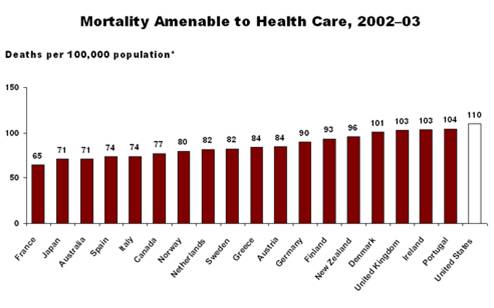
In "Measuring the Health of Nations: Updating an Earlier Analysis" (Health Affairs, Jan./Feb. 2008), Ellen Nolte, Ph.D., and C. Martin McKee, M.D., D.Sc., both of the London School of Hygiene and Tropical Medicine, compared international rates of "amenable mortality"—that is, deaths from certain causes before age 75 that are potentially preventable with timely and effective health care.

And you see what that tells us:

(Click Chart for Larger View)


Technorati tags: , , , , , , , ,

Saturday, November 24, 2007

Nevada Democratic Debate - Dennis Kucinich Interview

"This is [an] uncut interview with presidential candidate Dennis Kucinich, discussing health care, UFOs, and Peak Oil. Afterwards, his wife Eilizabeth [discusses] reopening the investigation of 9/11 and the possibility that Dennis might run on a ticket with Ron Paul."


Original Post: Raw Vegas

Technorati tags: , , , ,

Monday, July 16, 2007

No More Excuses

The Krug Man points out in today's Times op ed that "the opponents of universal health care appear to have run out of honest arguments."

The question is, what will Americans -- as in YOU -- do to demand universal health care?


The Waiting Game
By Paul Krugman
The New York Times
Being without health insurance is no big deal. Just ask President Bush. “I mean, people have access to health care in America,” he said last week. “After all, you just go to an emergency room.”

This is what you might call callousness with consequences. The White House has announced that Mr. Bush will veto a bipartisan plan that would extend health insurance, and with it such essentials as regular checkups and preventive medical care, to an estimated 4.1 million currently uninsured children. After all, it’s not as if those kids really need insurance — they can just go to emergency rooms, right?

O.K., it’s not news that Mr. Bush has no empathy for people less fortunate than himself. But his willful ignorance here is part of a larger picture: by and large, opponents of universal health care paint a glowing portrait of the American system that bears as little resemblance to reality as the scare stories they tell about health care in France, Britain, and Canada.

The claim that the uninsured can get all the care they need in emergency rooms is just the beginning. Beyond that is the myth that Americans who are lucky enough to have insurance never face long waits for medical care.

Actually, the persistence of that myth puzzles me. I can understand how people like Mr. Bush or Fred Thompson, who declared recently that “the poorest Americans are getting far better service” than Canadians or the British, can wave away the desperation of uninsured Americans, who are often poor and voiceless. But how can they get away with pretending that insured Americans always get prompt care, when most of us can testify otherwise?

A recent article in Business Week put it bluntly: “In reality, both data and anecdotes show that the American people are already waiting as long or longer than patients living with universal health-care systems.”

A cross-national survey conducted by the Commonwealth Fund found that America ranks near the bottom among advanced countries in terms of how hard it is to get medical attention on short notice (although Canada was slightly worse), and that America is the worst place in the advanced world if you need care after hours or on a weekend.

We look better when it comes to seeing a specialist or receiving elective surgery. But Germany outperforms us even on those measures — and I suspect that France, which wasn’t included in the study, matches Germany’s performance.

Besides, not all medical delays are created equal. In Canada and Britain, delays are caused by doctors trying to devote limited medical resources to the most urgent cases. In the United States, they’re often caused by insurance companies trying to save money.

This can lead to ordeals like the one recently described by Mark Kleiman, a professor at U.C.L.A., who nearly died of cancer because his insurer kept delaying approval for a necessary biopsy. “It was only later,” writes Mr. Kleiman on his blog, “that I discovered why the insurance company was stalling; I had an option, which I didn’t know I had, to avoid all the approvals by going to ‘Tier II,’ which would have meant higher co-payments.”

He adds, “I don’t know how many people my insurance company waited to death that year, but I’m certain the number wasn’t zero.”

To be fair, Mr. Kleiman is only surmising that his insurance company risked his life in an attempt to get him to pay more of his treatment costs. But there’s no question that some Americans who seemingly have good insurance nonetheless die because insurers are trying to hold down their “medical losses” — the industry term for actually having to pay for care.

On the other hand, it’s true that Americans get hip replacements faster than Canadians. But there’s a funny thing about that example, which is used constantly as an argument for the superiority of private health insurance over a government-run system: the large majority of hip replacements in the United States are paid for by, um, Medicare.

That’s right: the hip-replacement gap is actually a comparison of two government health insurance systems. American Medicare has shorter waits than Canadian Medicare (yes, that’s what they call their system) because it has more lavish funding — end of story. The alleged virtues of private insurance have nothing to do with it.

The bottom line is that the opponents of universal health care appear to have run out of honest arguments. All they have left are fantasies: horror fiction about health care in other countries, and fairy tales about health care here in America.

Photo Credit: Paul Krugman. (The New York Times)

Also See:

Saturday, July 14, 2007

Dr. Gupta's Bias


Bill Scher reports (Campaign for America's Future):

Michael Moore and CNN's Dr. Sanjay Gupta faced off yesterday on Larry King Live, following Moore's on-air criticism of Gupta's anti-SiCKO piece which accused Moore of "fudg[ing] some facts."

Moore, on his website, is ably taking Gupta to task on the factual points.

And as Huffington Post’s Rachel Sklar notes, during Larry King Live, “Moore cites his source for every statistic offered ... yet Gupta ignores it, all of it, including Moore restating, again, that all of this was available in this email [sent by Moore’s team to CNN] from June 28, 2007.”

But what was most striking was when Gupta showed the heart of his bias, a bias against having our government guarantee universal health care.

Gupta says to Moore, “You criticize the government so soundly. But you're willing to hand over one of our most precious commodities, our health care in this country, to the government.”

Moore rebutted, “I actually love our government ... It does a great job of administrating Social Security ... the problem is who we've put in power who holds office.”

Then in response, Gupta made a completely misleading attack on Medicare:

Michael, one of the best examples of health care, at least some sort of universal health care, would be Medicare. I think you would agree with that.

It's going to go bankrupt by 2019. It's going to be $28 trillion in debt by 2075...would you say that this is going to be still a working system 20 years from now?

Is this some evidence that our government can’t be directed to fix our broken health care system? Economist-blogger Dean Baker doesn’t think so:

CNN’s health care analyst is now telling people that Medicare is going bankrupt. What does this mean?

Medicare’s costs are projected to exceed its revenue and drain the surplus from its trust fund in a bit over a decade, but this has been true at several points in the past. Did Congress tell tens of millions of beneficiaries to get lost? No, Congress appropriated the money needed to keep the program going...

...If Dr. Gupta meant to imply that Medicare, as a government program is uniquely inefficient, then he is way off the mark. According to the Center for Medicare and Medicaid Services (Table 13) per beneficiary costs have risen in nominal dollars by 519.5 percent since 1980. By contrast, the cost per enrollee of private insurance has risen by 676.6 percent over this same period.

That gets at the heart of Gupta’s bias.

The pressures on Medicare’s finances are not the fault of our government, but of skyrocketing health care costs across the board.

Yet Gupta’s cherry-picks his facts to attack a government guarantee of universal care, and raise the prospect of dismantling Medicare, just like how conservatives sought to do the same with Social Security.

Health care costs are a major problem, but as Baker notes, “Eliminating Medicare would raise health care costs, not lower them.”

Whereas directing our government to ensure universal health care, as Medicare already does for seniors, can contain costs by pooling risk and maximizing bargaining power.

In the Health Care for America plan -- a Medicare-style public plan for those under 65 which would compete with private insurance – policy architect Jacob Hacker writes:

Because Medicare and the Health Care for America Plan would bargain jointly for lower prices and join forces to improve quality, they would have enormous combined leverage to hold down costs. Cross-national evidence and the historical experience of Medicare show conclusively that concentrated purchasing power is by far the most effective means by which to restrain the price of medical services...

...Other nations spend much less for the same medical services than we do because their insurance systems bargain for lower prices. And though Medicare covers less than a seventh of the U.S. population, it has still controlled costs substantially better than the private sector, especially since the introduction of payment controls in the mid-1980s.

When was the last time you saw a mainstream media report that merely raised the possibility that our government’s Medicare plan does a better job at containing costs than private insurance companies?

There is one thing said by Gupta that I have no disagreement with: “It makes it very hard to advance the argument if you're not getting the numbers right.”

Thanks to TomPaine.com.

Cartoon Credit: How to Save the World

Related Articles:

Sunday, July 08, 2007

America: SICKO Society

Another Krugman MUST READ op ed follows.

By the way, if you haven't yet seen Michael Moore's "SICKO" yet, do. If you see only one film this year -- see "SICKO." It ought to be required viewing for every citizen in this country.

The film will move you. It will surprise you. It will make you think. It will make you angry. Most important, it hopefully will make you DO SOMETHING: lobby your representatives loudly and ceaselessly for Universal Health Care.

Health Care Terror
By Paul Krugman
The New York Times
These days terrorism is the first refuge of scoundrels. So when British authorities announced that a ring of Muslim doctors working for the National Health Service was behind the recent failed bomb plot, we should have known what was coming.

“National healthcare: Breeding ground for terror?” read the on-screen headline, as the Fox News host Neil Cavuto and the commentator Jerry Bowyer solemnly discussed how universal health care promotes terrorism.

While this was crass even by the standards of Bush-era political discourse, Fox was following in a long tradition. For more than 60 years, the medical-industrial complex and its political allies have used scare tactics to prevent America from following its conscience and making access to health care a right for all its citizens.

I say conscience, because the health care issue is, most of all, about morality.

That’s what we learn from the overwhelming response to Michael Moore’s “Sicko.” Health care reformers should, by all means, address the anxieties of middle-class Americans, their growing and justified fear of finding themselves uninsured or having their insurers deny coverage when they need it most. But reformers shouldn’t focus only on self-interest. They should also appeal to Americans’ sense of decency and humanity.

What outrages people who see “Sicko” is the sheer cruelty and injustice of the American health care system — sick people who can’t pay their hospital bills literally dumped on the sidewalk, a child who dies because an emergency room that isn’t a participant in her mother’s health plan won’t treat her, hard-working Americans driven into humiliating poverty by medical bills.

“Sicko” is a powerful call to action — but don’t count the defenders of the status quo out. History shows that they’re very good at fending off reform by finding new ways to scare us.

These scare tactics have often included over-the-top claims about the dangers of government insurance. “Sicko” plays part of a recording Ronald Reagan once made for the American Medical Association, warning that a proposed program of health insurance for the elderly — the program now known as Medicare — would lead to totalitarianism.

Right now, by the way, Medicare — which did enormous good, without leading to a dictatorship — is being undermined by privatization.

Mainly, though, the big-money interests with a stake in the present system want you to believe that universal health care would lead to a crushing tax burden and lousy medical care.

Now, every wealthy country except the United States already has some form of universal care. Citizens of these countries pay extra taxes as a result — but they make up for that through savings on insurance premiums and out-of-pocket medical costs. The overall cost of health care in countries with universal coverage is much lower than it is here.

Meanwhile, every available indicator says that in terms of quality, access to needed care and health outcomes, the U.S. health care system does worse, not better, than other advanced countries — even Britain, which spends only about 40 percent as much per person as we do.

Yes, Canadians wait longer than insured Americans for elective surgery. But over all, the average Canadian’s access to health care is as good as that of the average insured American — and much better than that of uninsured Americans, many of whom never receive needed care at all.

And the French manage to provide arguably the best health care in the world, without significant waiting lists of any kind. There’s a scene in “Sicko” in which expatriate Americans in Paris praise the French system. According to the hard data they’re not romanticizing. It really is that good.

All of which raises the question Mr. Moore asks at the beginning of “Sicko”: who are we?

“We have always known that heedless self-interest was bad morals; we know now that it is bad economics.” So declared F.D.R. in 1937, in words that apply perfectly to health care today. This isn’t one of those cases where we face painful tradeoffs — here, doing the right thing is also cost-efficient. Universal health care would save thousands of American lives each year, while actually saving money.

So this is a test. The only things standing in the way of universal health care are the fear-mongering and influence-buying of interest groups. If we can’t overcome those forces here, there’s not much hope for America’s future.

Photo Credit: Paul Krugman. (The New York Times)

Also See:

Thursday, July 05, 2007

A National Gut-Check: Who Lives Better?

By Timothy Egan
Guest Columnist

The New York Times
"One of the memorable scenes in 'Sicko,' Michael Moore’s latest cinematic provocation, comes from France, where he shows doctors in their little white cars making house calls — for free.

But it’s not just France. When we lived in Italy some time ago, a doctor came to our farmhouse rental on Easter Sunday morning to diagnose a stomach ailment. He charged nothing.

Let’s stipulate that Moore is a one-sided pamphleteer, with a bit of Mark Twain and Pat Robertson in his schtick. But like all propagandists, his job is not to find some objective truth, but to anger, challenge, ask hard questions.

With Independence Day just passed, a good nationalist shouldn’t be afraid to answer those questions. So, who lives better, us or them?

In Italy, this was a regular parlor game when friends came to visit. Inevitably, after a few days of taking in our new world — a village public school for the kids, neighbors who opened the doors of their ancient homes to us, a lengthy siesta every afternoon — our houseguests would side with the Italians. I would counter for the U.S.A., to keep the argument alive.

The Italians won on health, family and food. The United States was better on race and opportunity.

With health care, the anecdotal often carried the argument. One day, a tenant farmer named Sergio, our neighbor, woke with a terrible eye infection. He was full of pain, unable to see. Sergio got world-class care in Florence. After three days of attentive fussing in the hospital, he came home entirely well and without a bill.

Had he showed up at any American hospital — poor, no insurance — well, good luck. Especially in a place like Texas, where 30 percent of adults lack health insurance and what can pass for medical care is a get-in-line form of triage.

But even with insurance, Americans are stuck with what may be the worst of all systems: one that lets a handful of corporations make life-and-death decisions, with incentive to dump and deny.

Little wonder that the United States ranks 37th in effectiveness of health care. Italy ranks 2nd. This is a country that can’t form a government to last longer than the soccer season, and yet, they make our medical system look barbaric.

If our system doesn’t kill you — see the infant mortality and life expectancy rates, bringing up the rear — it can put you in the poorhouse. Medical catastrophes are the leading cause of bankruptcy, and most of those are people who have some insurance, clinging to the frayed edge of the middle class.

O.K., so what about leisure? Americans spend nearly a third of their disposable income on good times, baby. But we can’t relax. Sorry — no time. Lunch averages 31 minutes. And the U.S. ranks dead last among 21 of the world’s richest countries when it comes to guaranteed days off, according to the Center for Economic and Policy Research.

Most Americans don’t even use their allotted days of leisure. The Italians take 42 vacation days a year — No. 1 in the world. The average American takes 13.

A quarter of Americans receive no vacation at all. And it’s not like we don’t need it: one in three are chronically overworked. We even work 100 hours a year more than the Japanese.

President Bush has it figured out, with his month off at the ranch. But for a profile in clueless, Bush set the mark when he lauded as truly American some citizen who told him she had to work three jobs. Ain’t that something?

Ah, but what about taxes? Europeans pay more than we do, to fund that free health care. Take that, Euro-trash, while lying on the beach. And yet, our tax system is approaching Gilded Age disparity. Listen to Warren Buffett, the third richest man in the world. Last year, he was taxed at 17 percent of his taxable income, he said last month. His receptionist paid nearly twice that, at 30 percent.

Where America shines is with our multiracial society and the easy access to opportunity. It was jarring to listen to otherwise thoughtful Tuscans denigrate Ethiopian immigrants or even their Sicilian countrymen.

By contrast, nothing made me prouder than telling Italians that I came from a place with an African-American mayor and a Chinese-American governor. Or that I grew up in a big Irish-American family with little money.

A patriot should not be afraid to have this debate, vigorously — after a nap.

Timothy Egan, a former Seattle correspondent for The Times and the author of 'The Worst Hard Time,' is a guest columnist."

Monday, June 18, 2007

When Dollars Trump Compassion

By Bob Herbert
The New York Times
You won’t see these stories on television, but Marian Wright Edelman and Dr. Irwin Redlener could talk to you all day and all night about children whose lives have been lost or ruined because they didn’t have health insurance.

This is not a situation one associates with a so-called advanced country. That you can have sick children wasting away in the United States, the wealthiest nation on the planet, because medical treatment that could relieve their suffering is withheld by men and women with dollar signs instead of compassion in their eyes is beyond unconscionable.

Ms. Edelman is the president of the Children’s Defense Fund, and Dr. Redlener is president of the Children’s Health Fund.

Both are appalled at the embarrassing fact that nine million American children have no health coverage at all. Among them are children with diabetes, chronic asthma, heart conditions, life-threatening allergies and so on. In many instances they are left untreated until it is too late.

Leaving children uninsured is a form of Russian roulette, Dr. Redlener said.

“All children should be covered,” said Ms. Edelman.

Congress and the president could do something about this right now. Of the nine million children without coverage, six million are already eligible for either Medicaid or the popular State Children’s Health Insurance Program, or S-chip, which covers children whose parents earn too much to qualify for Medicaid but too little to afford private health insurance. The bulk of the funding for S-chip comes from the federal government.

S-chip, which had strong bipartisan support when it was established 10 years ago, is currently up for reauthorization in Congress. The program should be expanded as part of a broader effort to cover as many of the six million eligible-but-uninsured kids as possible.

Eligible children remain outside of S-chip and Medicaid for a variety of reasons, including the following: because there is insufficient funding to cover them; because families do not realize their children qualify for coverage; because red tape and complicated regulations discourage families from signing up.

A number of S-chip re-authorization proposals are being developed. The best-case scenario would be legislation — costing as much as $50 billion in additional funding over the next five years — that would cover millions of additional youngsters from poor and working-poor families. This would put the U.S. on the road toward universal coverage for children.

Ten billion dollars a year is considered a pittance when it comes to funding wars and tax cuts for the very wealthy. But it’s suddenly a lot of money when the subject is the health of American children.

One of the worst scenarios has been offered by President Bush in his White House budget proposal. That calls for just $4.8 billion in new funding for S-chip over the next five years. The result, according to the Congressional Budget Office, would be a net loss of coverage for 1.4 million children.

The old expression was “taking candy from a baby.” The White House is ready to take away vitally needed medicine.

Negotiations over the reauthorization of S-chip are under way. It will be interesting to see whether the Democrats who crowed so much about their newfound power when they took control of Congress will stand tall for the kids of the poor and working poor, and whether there are enough caring Republicans to resurrect the spirit of bipartisanship from a decade ago.

As the heat gets turned up on this issue, the White House appears to be falling into its old habit of creating its own reality.

The Congressional Budget Office and most researchers have agreed on the six million figure for the number of youngsters who are eligible for government-sponsored health coverage but remain unenrolled — roughly four million for Medicaid and two million for S-chip. This has not been controversial.

Yesterday, the Department of Health and Human Services began circulating a study that tries to make the case that the total number of eligible but uninsured youngsters is a mere 794,000, an absurdly low figure.

If you can wave a magic wand and make five million poor kids disappear, you no longer have to think about caring for them.

Advocates like Dr. Redlener and Ms. Edelman don’t have that luxury.

“Kids who grow up with poor access to health care carry a high risk of having underdiagnosed and undertreated chronic illness, both physical and emotional,” said Dr. Redlener. “We know what to do. We should fully fund this effort at the $50 billion level and make coverage mandatory for all children.”
Photo Credit: Bob Herbert. (The New York Times)

An Hour with Michael Moore

Amy Goodman (Democracy Now!) interviews Michael Moore on "Sicko," his Trip to Cuba with 9/11 Rescue Workers, the Removal of Private Healthcare Companies & Clinton's Ties to Insurance Companies: "They're into Her Pocket and She's Into Their Pocket And I Don't Expect Much From Her."

Read the transcript.

By all means, see "SICKO" starting June 29th at a theatre near you.

Until then, watch the trailer (below):


Monday, June 04, 2007

Krugman Debates Health Care

The Krug Man parses through political spin to analyze the differences between the Obama, Edwards, and Clinton "proposals."

I come out exactly where he is -- especially his characterization of Obama as being so obsessed with bridging the bitter partisan divide, he offers overly cautious, less-than-inspired policy proposals.


Obama in Second Place
By Paul Krugman
The New York Times
One of the lessons journalists should have learned from the 2000 election campaign is that what a candidate says about policy isn’t just a guide to his or her thinking about a specific issue — it’s the best way to get a true sense of the candidate’s character.

Do you remember all the up-close-and-personals about George W. Bush, and what a likeable guy he was? Well, reporters would have had a much better fix on who he was and how he would govern if they had ignored all that, and focused on the raw dishonesty and irresponsibility of his policy proposals.

That’s why I’m not interested in what sports the candidates play or speculation about their marriages. I want to hear about their health care plans — not just for the substance, but to get a sense of what kind of president each would be. Would they hesitate and triangulate, or would they push hard for real change?

Now, back in February John Edwards put his rivals for the Democratic nomination on the spot, by coming out with a full-fledged plan to cover all the uninsured. Suddenly, vague expressions of support for universal health care weren’t enough: candidates were under pressure to present their own specific plans.

And the question was whether those plans would be as bold and comprehensive as the Edwards proposal.

Four months have passed since then. So far, all Hillary Clinton has released are proposals to help reduce health care costs. It’s worthy stuff, but it’s hard to avoid the sense that she’s putting off dealing with the hard part. The real test is how she proposes to cover the uninsured.

But last week Barack Obama, after getting considerable grief for having failed to offer policy specifics, finally delivered a comprehensive health care plan. So how is it?

First, the good news. The Obama plan is smart and serious, put together by people who know what they’re doing.

It also passes one basic test of courage. You can’t be serious about health care without proposing an injection of federal funds to help lower-income families pay for insurance, and that means advocating some kind of tax increase. Well, Mr. Obama is now on record calling for a partial rollback of the Bush tax cuts.

Also, in the Obama plan, insurance companies won’t be allowed to deny people coverage or charge them higher premiums based on their medical history. Again, points for toughness.

Best of all, the Obama plan contains the same feature that makes the Edwards plan superior to, say, the Schwarzenegger proposal in California: it lets people choose between private plans and buying into a Medicare-type plan offered by the government.

Since Medicare has much lower overhead costs than private insurers, this competition would force the insurance industry to cut costs — making our health-care system more efficient. And if private insurers couldn’t or wouldn’t cut costs enough, the system would evolve into Medicare for all, which is actually the best solution.

So there’s a lot to commend the Obama plan. In fact, it would have been considered daring if it had been announced last year.

Now for the bad news. Although Mr. Obama says he has a plan for universal health care, he actually doesn’t — a point Mr. Edwards made in last night’s debate. The Obama plan doesn’t mandate insurance for adults. So some people would take their chances — and then end up receiving treatment at other people’s expense when they ended up in emergency rooms. In that regard it’s actually weaker than the Schwarzenegger plan.

I asked David Cutler, a Harvard economist who helped put together the Obama plan, about this omission. His answer was that Mr. Obama is reluctant to impose a mandate that might not be enforceable, and that he hopes — based, to be fair, on some estimates by Mr. Cutler and others — that a combination of subsidies and outreach can get all but a tiny fraction of the population insured without a mandate. Call it the timidity of hope.

On the whole, the Obama plan is better than I feared but not as comprehensive as I would have liked. It doesn’t quell my worries that Mr. Obama’s dislike of “bitter and partisan” politics makes him too cautious. But at least he’s come out with a plan.

Senator Clinton, we’re waiting to hear from you.

Wednesday, May 30, 2007

The Obama Health Plan

By Atul Gawande
New York Times Guest Columnist
As a surgeon, I’ve worked with the veterans’ health system, Medicare, Medicaid and private insurance companies. I’ve seen health care in Canada, Britain, Switzerland and the Netherlands. And I was in the Clinton administration when our plan for universal coverage failed. So, with a new health reform debate under way, what I want to tell you in my last guest column is this:

First, there is not a place in this world that is not struggling to control health costs while providing high-quality, easily accessible care. No one — no one — has a great solution.

But second, whether as a doctor or as a citizen, I would take almost any system — from Medicare-for-all to a private insurance voucher system — over the one we now have. Job-based insurance is bleeding away the viability of American businesses — even doctors complain about the cost of insuring employees. And it has left large numbers of patients without adequate coverage when they need it. In the last two years, for example, 51 percent of Americans surveyed did not fill a prescription or visit a doctor for a known medical issue because of cost.

My worry is less about what happens if we change than what happens if we don’t.

This week, Barack Obama released his health reform plan. It’s a puzzle how you are supposed to regard presidential candidates’ proposals. They are treated, by campaigns and media alike, as some kind of political G.P.S. device — gadgets primarily for political positioning. So this was how Mr. Obama’s plan was reported: it is a lot like John Edwards’s plan and the Massachusetts plan signed into law by Mitt Romney last year; and it has elements of John Kerry’s proposal from four years ago. In other words — ho hum — another centrist plan. No one except policy wonks will tell the proposals apart from one another.

Well, all this may be true. And if what you care about is which candidate can one-up the others, it is rather disappointing. But if what you care about is whether, after the 2008 election, we’ll be in a position to finally stop the health systems’ downward spiral, the similarity of the emerging proposals is exactly what’s interesting. I don’t think you can call it a consensus, but there is nonetheless a road forward being paved and a growing number of people from across the political spectrum are on it — not just presidential candidates, but governors from California to Pennsylvania, unions and businesses like Safeway, ATT and Pepsi.

This is what that road looks like. It is not single-payer. It instead follows the lead of European countries ranging from the Netherlands to Switzerland to Germany that provide universal coverage (and more doctors, hospitals and access to primary care) through multiple private insurers while spending less money than we do. The proposals all define basic benefits that insurers must offer without penalty for pre-existing conditions. They cover not just expensive sickness care, but also preventive care and cost-saving programs to give patients better control of chronic illnesses like diabetes and asthma.

We’d have a choice of competing private plans, and, with Edwards and Obama, a Medicare-like public option, too. An income-related federal subsidy or voucher would help individuals pay for that coverage. And the proposals also embrace what’s been called shared responsibility — requiring that individuals buy health insurance (at minimum for their children) and that employers bigger than 10 or 15 employees either provide health benefits or pay into a subsidy fund.

It is a coherent approach. And it seems to be our one politically viable approach, too. No question, proponents have crucial differences — like what the individual versus employer payments should be. And attacks are certain to label this as tax-and-spend liberalism and government-controlled health care. But these are not what will sabotage success.

Instead, the crucial matter is our reaction as a country when the attacks come. If we as consumers, health professionals and business leaders sit on our hands, unwilling to compromise and defend change, we will be doomed to our sliding global competitiveness and self-defeating system. Avoiding this will take extraordinary political leadership. So we should not even consider a candidate without a plan capable of producing agreement.

The ultimate measure of leadership, however, is not the plan. It is the capacity to take that plan and persuade people to find common ground in it. The politician who can is the one we want.

Atul Gawande, a surgeon at Brigham and Women’s Hospital in Boston and a New Yorker staff writer, is the author of the new book “Better.” He has been a guest columnist this month.

Monday, May 21, 2007

Kristof on Health Care

Amen.

A Short American Life
By Nicholas D. Kristof
The New York Times
How’s this for a glimpse into America’s health care mess:

The student winner I’ve chosen to accompany me on a reporting trip to Africa next month is a superb medical school student named Leana Wen. She receives her M.D. this month, and will research health care access this summer at a Washington think tank.

I asked Leana about her health insurance coverage, just in case she catches leprosy on the Africa trip.

“Actually, I was going to become one of the 45 million uninsured for the summer,” she said. “The think tank does not provide insurance for ‘temporary’ employees, and my school did not allow extension of health insurance post-graduation. I still haven’t found a reasonably priced insurance plan for this period.”

Aaaaargh! When a newly minted doctor investigating Americans’ access to medical care has no insurance — then you know that our health care system is truly bankrupt.

Let’s hope that the presidential campaign helps lead us toward a new health care system. John Edwards has set the standard by proposing a serious and detailed plan for national health care reform, and other candidates should follow.

The medical and insurance lobbies have been busy blocking national health care programs since they were first seriously proposed back in the 1920’s — and the result has been millions of premature deaths in this country because of people falling through the cracks. Doctors fighting universal coverage have been saving lives in their day jobs while costing lives with their lobbying.

Over all, a person without insurance is less likely to have diseases diagnosed early, less likely to get routine preventive care — and faces a 25 percent greater chance of dying early.

Americans with good jobs and complex needs receive superb medical care. But a child in Costa Rica born today is expected to live longer than an American child born today.

The U.S. now spends far more on medical care (more than $7,000 per person) than other nations, yet our infant mortality rate, maternal mortality rate and longevity are among the worst in the industrialized world. If we had as good a child mortality rate as France, Germany and Italy, we would save 12,000 children a year.

It is disgraceful that an American mother has almost three times the risk of losing a child as a mother in the Czech Republic. According to a new report from Save the Children, a woman in the U.S. has a 1-in-71 chance of losing a child before his or her fifth birthday.

Some speculate that America’s high infant mortality rate is partly a result of greater honesty about neonatal deaths or of more in vitro fertilizations. But even if those are factors, they don’t explain why a woman is 50 percent more likely to die in childbirth in the U.S. than in Europe.

The existing medical financing system also creates perverse incentives for expensive procedures; that may be why Americans are far more likely than Europeans to get C-sections. Meanwhile, the burden of paying for these second-rate statistical outcomes is crippling American business. By next year, the average Fortune 500 company will spend more on health care than it earns in net income, according to Steve Burd, the head of Safeway. Mr. Burd and other executives have formed the Coalition to Advance Healthcare Reform, creating a corporate constituency for national health reforms.

There’s evidence that the most efficient financing system would be a single-payer structure, such as that found in most Western countries. Some 31 percent of U.S. health spending goes to administration, more than twice the rate in Canada.

So bravo to Physicians for a National Health Program, a group of 14,000 doctors and other health professionals that favors a single-payer system.

But universal coverage is only part of the answer. We also need far greater attention to public health programs focusing on prevention. Two of the most important life-saving health interventions in recent decades weren’t medical at all: the cigarette tax and laws mandating air bags and seat belt use. A national public health campaign on obesity (similar to the one Gov. Mike Huckabee started in Arkansas) should be an essential component of health care reform.

Even if a single-payer system isn’t politically possible right now, universal coverage is feasible through other mechanisms — as Massachusetts has shown. We need to hold the presidential candidates accountable, for universal coverage is an idea whose time came in the 1920s. We should insist we get it before the 2020s.

Photo Credit: Nicholas Kristof. (Fred R. Conrad/The New York Times)