Showing posts with label Russia. Show all posts

Tuesday, September 02, 2008

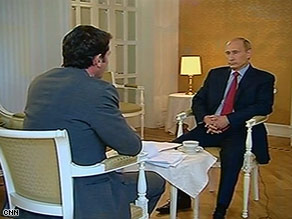
CNN Interviews Putin

The following three-part series is an interview, held on August 28, between CNN's Matthew Chance and Russian prime minister Vladimir Putin. The CNN transcript is available here. Following the three-part series is the truncated version broadcast for Western audiences.

Please Watch and Share Widely:
iNoodle.com: CNN Interviews Putin (Video-English subtitles)

Related:

Thanks to Sean Madden, iNoodle.com

Monday, September 01, 2008

Living in a Lying Nation

Below is a piece written by Sean M. Madden, iNoodle.com, in response to today's BBC Radio 4's Today program about the conflict in Georgia and, specifically, today's scheduled EU summit meeting to decide what the West's response will be "in the wake of [Russia's] invasion of Georgia."

This is a must read (as is Sean's Blog, iNoodle.com):
Living in a Lying Nation
By Sean M. Madden
iNoodle.com
"... I had hoped when I moved to Britain three years ago—for my wife to return to her native home after living in the U.S. with me for twelve years—that the world-renowned British press would prove to be more critical of, less beholden to, the criminal powers that be.

Worse, they are every bit as criminally complicit as their American counterparts...."
Photo credit: Sean M. Madden. (iNoodle.com)

Sean M. Madden is an American writer-educator living in East Sussex, England. His articles have been headlined by a wide range of online media outlets, including Information Clearing House, United Press International’s ReligionAndSpirituality.com, Guerrilla News Network, Online Journal, Atlantic Free Press, Scoop, OpEdNews.com, Thomas Paine’s Corner, Carolyn Baker’s popular website and the Populist Party of America’s website. Sean also edits and writes for his iNoodle.com and MindfulLivingGuide.com blogs, and welcomes correspondence from readers. His email address is sean@inoodle.com.

Wednesday, August 27, 2008

Running for War President at Any Cost

Robert Scheer, Truthdig, reports:
Just great! Nuclear-armed Pakistan is falling apart, Iran’s nuclear program is unchecked and congressional legislation on cooperation with the Russians on controlling nuclear proliferation is now dead in the water. Horrid news except for Sen. John McCain, who thrills to a repeat of the danger lines of the Cold War...
read more | digg story

Wednesday, July 18, 2007

Not Ready for Mainstream News

Turn off your TV. Watch the video. Get mad. Do something about it.


"Misunderstanding arising from ignorance breeds fear, and fear remains the greatest enemy of peace." -- Lester B. Pearson
  • Kissinger’s Secret Meeting With Putin | By Mike Whitney:
    "When a political heavyweight, like Henry Kissinger, jets-off on a secret mission to Moscow; it usually shows up in the news. Not this time...."
  • Lies, More Lies, And Damn Lies | By Eric Margolis:
    "As the White House now ponders an attack on Iran, we would do well to recall the famed words of King Pyrrhus of Epirus, `one more such victory and we are ruined.' ..."
  • Ship of fools: Johann Hari sets sail with America's swashbuckling neocons | The Independent:
    "The Iraq war has been an amazing success, global warming is just a myth – and as for Guantanamo Bay, it's practically a holiday camp... The annual cruise organised by the 'National Review', mouthpiece of right-wing America, is a parallel universe populated by straight-talking, gun-toting, God-fearing Republicans...."
  • U.S. intelligence advisors see failure in fight with Al Qaeda in Pakistan | International Herald Tribune:
    "President George W. Bush's top counterterrorism advisers acknowledged Tuesday that the strategy for fighting Osama bin Laden's leadership of Al Qaeda in Pakistan had failed, as the White House released a grim new intelligence assessment that has forced the administration to consider more aggressive measures inside Pakistan...."
  • The State | Pakistan criticizes U.S. terror warning:
    "A U.S. intelligence report that al-Qaida is regrouping in northwest Pakistan is unsubstantiated, Pakistan said Wednesday, and it asked Washington to provide it with 'actionable intelligence.'"
  • Peter Galbraith | The War Is Lost:
    Former ambassador Peter Galbraith, vividly lays out the dismal state of Iraq and the various catastrophes likely to flow from most of the major "benchmarks" established by the Bush administration and Congress, if they were ever to become reality.
  • Iran: 2nd Round of Talks With U.S. Soon | Guardian Unlimited:
    "Iran's foreign minister said Wednesday that his government had accepted a U.S. request for ambassador-level talks on Iraq, to be held 'in the near future.'..."
  • Guardian Unlimited: Bush's new faith-based strategy:
    "Has God sent a reminder to the amnesiac president of the United States? How else to account for George Bush's sudden and belated announcement of an international peace conference on the Middle East? It was back in 2003 that the US President reported an even earlier divine directive as told to the Palestinian leaders Abu Mazen and Nabil Shaath:

    I'm driven with a mission from God. God would tell me, 'George, go and fight those terrorists in Afghanistan.' And I did, and then God would tell me, 'George, go and end the tyranny in Iraq ...'. And I did. And now, again, I feel God's words coming to me, 'Go get the Palestinians their state and get the Israelis their security, and get peace in the Middle East'. And by God I'm gonna do it.

    Presumably Jehovah, operating on an eternal time scale, thought that half a decade or so of indolence on the Israel/Palestine file would not make a difference...."
  • YouTube |Your Cell Phone: FBI can listen even when phone is turned off

  • 911Truth.org | US Social Forum Supports Call for Independent, International Investigation into 9/11
    "Thanks to donations from some of our generous supporters, 911truth.org was present at the first ever United States Social Forum, along with 15 other 9/11 truth activists from six states. We attended with the idea we'd have to convince people to look at the need for a real investigation, but what we learned was that most everyone was already aware of some important 9/11 questions and agreed with us! Even better, we introduced a Resolution demanding an "independent, international investigation of 9/11" which received resounding applause by thousands in attendance at the final Peoples Assembly!..."
  • Bush Middle East plan starts to unravel | The Guardian:
    "George Bush yesterday encountered the weakest of welcomes for his call for an international peace conference on the Middle East.A day after he unveiled his plan for a conference of Israelis, Palestinians and Arab governments in the autumn, there were few signs of optimism that such a gathering could produce a final resolution to the conflict...."
  • AlterNet: If This Is Such a Rich Country, Why Are We Getting Squeezed?:
    Heather Boushey and Joshua Holland report for AlterNet on the contradictory stories of the American economy, where the stock market continues to boom, but at the same time Americans are told their government is unable to pay for a "robust social net.
  • Robert Scheer | King George W.:� James Madison's Nightmare:
    "George W. Bush is the imperial president that James Madison and other founders of this great republic warned us about.� He lied the nation into precisely the %u201Cforeign entanglements%u201D that George Washington feared would destroy the experiment in representative government, and he has championed a spurious notion of security over individual liberty, thus eschewing the alarms of Thomas Jefferson as to the deprivation of the inalienable rights of free citizens.� But most important, he has used the sledgehammer of war to obliterate the separation of powers that James Madison enshrined in the U.S. Constitution."
  • Administration Drug Officials Appeared With GOP Candidates:
    "White House officials arranged for top officials at the Office of National Drug Control Policy to help as many as 18 vulnerable Republican congressmen by making appearances and sometimes announcing new federal grants in the lawmakers' districts in the months leading up to the November 2006 elections, a Democratic lawmaker said yesterday...."
  • AlterNet: Bush Government to Poor Voters: We Don't Want You to Vote
    "The Justice Department is pressuring 10 states to purge their voter rolls, while states are ignoring laws to help low-income Americans register to vote...."
  • Energy firms' role in policy? | Washington Post:
    "After a six-year battle the record of who Cheney created our nation's energy policy with is published, and it isn't a pretty picture....."

Wednesday, May 16, 2007

Iran Courts the US at Russia's Expense

MUST READ:

The Asia Times reports:
Iran's relations with the Arab world have taken a dramatic turn for the better, in light of Iran's overtures toward the Arab states of the Persian Gulf, as well as in President Mahmud Ahmadinejad's announcement that Iran is prepared to resume full diplomatic relations with Egypt.

That announcement was made on Monday as Ahmadinejad visited the United Arab Emirates and received a rousing official welcome. Widely interpreted as Iran's timely response to US Vice

President Dick Cheney's tour of the region and his warning that the United States will not allow Iran to develop nuclear weapons or to dominate the region, Ahmadinejad's arrival in Dubai coincided with an Iranian olive branch toward not only Egypt but also the US. This is illustrated by Tehran's announcement that it has accepted the United States' invitation for direct talks between American and Iranian ambassadors in Baghdad.

"Iran's foreign policy is moving in the direction of constructive engagement on all fronts," a member of Iran's parliament, the Majlis, announced, adding that the resumption of relations with Egypt will have "positive effects on the whole region"....

Monday, April 02, 2007

US to Strike Iran on Good Friday?

Russian media: Assault could be carried out by jets, warships stationed in Gulf.

Here it comes, folks. Consider yourselves warned. This is not being reported in the U.S. mainstream press, but it is being reported in Israel and Russia.

PLEASE DISTRIBUTE WIDELY .....

The Jerusalem Post and AP report:
The United States will be ready to launch a missile attack on Iran's nuclear facilities as soon as early this month, perhaps "from 4 a.m. until 4 p.m. on April 6," according to reports in the Russian media on Saturday.

According to Russian intelligence sources, the reports said, the US has devised a plan to attack several targets in Iran, and an assault could be carried out by launching missiles from fighter jets and warships stationed in the Persian Gulf.

Russian news agency RIA Novosti quoted a security official as saying, "Russian intelligence has information that the US Armed Forces stationed in the Persian Gulf have nearly completed preparations for a missile strike against Iranian territory."

The Russian Defense Ministry rejected the claims of an imminent attack as "myths." There was no immediate response from Washington.

The reports come as the Iranian chief of staff, Hassan Fayrouz Abadi, was quoted on Saturday by Iran's Fars news agency warning leaders of Arab countries that Israel plans to open a "suicidal attack" on its neighbors this summer, to "prevent the withdrawal of the US troops from Iraq and the area."

"I warn the dear leaders and Muslim brothers in the neighboring countries of the occupied territories that this suicidal attack of the Zionists is threatening them," he said.

The countries in danger, he said, were "Lebanon and Syria, and later Egypt, Jordan and Saudi Arabia."

Also on Saturday, Russia urged Britain and Teheran to resolve the dispute over 15 British sailors and marines captured by Iran last week, a local news agency reported.

Russian Foreign Ministry spokesman Mikhail Kamynin urged the two sides to provide the United Nations with their own assessments as to what happened and where exactly the detention occurred so that the body could conduct an independent probe.

"We hope these actions will provide a foundation for the soonest possible resolution of the crisis," Kamynin was quoted as saying by the Interfax news agency.

Iranian President Mahmoud Ahmadinejad insisted that the captured British sailors and marines trespassed in Iranian waters and called world powers "arrogant" for failing to apologize, the country's official news agency reported.

"The British occupier forces did trespass our waters. Our border guards detained them with skill and bravery. But arrogant powers, because of their arrogant and selfish spirit, are claiming otherwise," IRNA quoted Ahmadinejad as saying during a speech in the southeastern city of Andinmeshk.

The European Union grappled with a double bind over Iran Saturday - the country's nuclear program and its seizure of the British troops - and reported no progress on either issue.

A debate about Iran's nuclear ambitions had been scheduled as a key agenda item but "was overshadowed to a certain extent by the issue of the sailors and marines," German Foreign Minister Frank-Walter Steinmeier said after hosting a two-day EU foreign ministers meeting in Bremen, Germany.

The Foreign Ministry in Iran dismissed the EU's "biased and meddlesome" comments on the captured troops, saying the dispute solely involved the governments of Iran and Britain.

Speaking to reporters in Bremen, British Foreign Secretary Margaret Beckett urged Iran to resolve the crisis over the military personnel peacefully, saying London remains open to dialogue.

"We encourage Iran to peacefully resolve this issue," she said.

"We continue to express our willingness to engage in dialogue and discussions with Iran," she added. "That is very much in the best interest of our people and that is our foremost concern."

"I think everyone regrets that this position has arisen," she said. "What we want is a way out of it."

Photo Credit: A flight deck crew passes by a fighter jet as it prepares to take off on the second day of operations on board of the USS John C. Stennis Wednesday in Persian Gulf waters. (AP)

Also See:

Thursday, February 15, 2007

Will Russia Bet on Its People or Its Oil Wells?

By Thomas L. Friedman
The New York Times
In a high-rise building with a view of Lenin’s Tomb, the U.S. aerospace giant Boeing is designing key parts of its new 787 Dreamliner, using hundreds of Russian aerospace engineers. Yes, President Putin may be talking cold-war tough, but down the street from the Kremlin, America’s crown jewel industrial company is using Russia’s crown jewel brainpower to design its next crown jewel jetliner.

Boeing’s Moscow Design Center, which employs 1,400 Russian engineers (earning less than their U.S. counterparts) on various projects, symbolizes Russia’s unique potential: Russia is that rare country that not only has a treasure trove of natural resources — oil, gas and mines — but also has a treasure trove of human talent: engineers, mathematicians and other valuable minds.

Most nations with highly developed human talent — like Singapore or Taiwan — have few natural resources, and those that are rich in natural resources — Venezuela or Sudan — tend not to develop their people’s talents. The exceptions, like Norway, which is rich in both human and natural resources, usually built their democratic institutions before they got rich on oil, so the money was well spent.

The meta-question with Russia today is this: Will it become more like Norway, a democracy enriched by oil, or more like Venezuela, a democracy subverted by oil? Is the Boeing center Russia’s future or its exception?

You see signs of both trends. On the positive side, Russia has been smarter than most petro-states. It has set up a rainy day fund and tucked away $100 billion from its oil and gas windfall. Direct foreign investment in Russia hit $30 billion last year, according to The Economist, and not all of it goes to the oil and gas sector anymore.

And then there’s Boeing. Its impressive Moscow center operates two shifts of engineers: 7 a.m. until 3 p.m., and 3 p.m. until 11 p.m. — which is shortly before the workday begins in the United States. A Russian Boeing engineer might be designing part of the 787’s nose during his day, and then initials and stores his work in the computer. A U.S. Boeing engineer, working on an identical computer, then picks it up during her day and engineers it some more. With regular teleconferences, it’s as if they are in one virtual 24-hour office.

“There is no paper at all,” said Sergei Korolev, the deputy head of Boeing Moscow. “We do the presentations electronically and have online sessions with Wichita and Seattle, and everyone looks at the same part and talks about it. Our center is the reason people are not emigrating.”

But Russia has a unique legacy in aerospace from Soviet days, so the educational centers and talent were in place for Boeing to tap. What Russia still glaringly lacks is an ecosystem of secure property rights, venture capitalists and homegrown innovators, and universities and business schools churning out idea-entrepreneurs. “Made in Russia” will never be a global brand as long as research spending by Russian companies remains among the lowest in the world.

The Moscow Times recently reported that only two Russian colleges — Moscow State and St. Petersburg State — are listed among the world’s top 500 universities. When you walk down the streets in Bangalore, India’s high-tech capital, it feels as if there’s a computer school or English-language school on every street. You walk in Moscow, and it feels as if there is a new shoe store or beauty salon on every street.

A former top aide to President Putin remarked to me that Russia had a huge interest in building a postindustrial knowledge economy, not an energy-intensive industrial one, so it can export most of its oil and gas, not consume them at home. But that would take a big investment in education, which is not being done.

Noting that Russia today spends far less of its G.D.P. on higher education than Europe or America, Sergei Guriyev, rector of Russia’s New Economic School, wrote in The Moscow Times, “Russians simply are not prepared to pay the taxes that would be necessary to finance science and education at Soviet-era levels, and no incentives have been created to attract more private funding.”

So here’s my prediction: You tell me the price of oil, and I’ll tell you what kind of Russia you’ll have. If the price stays at $60 a barrel, it’s going to be more like Venezuela, because its leaders will have plenty of money to indulge their worst instincts, with too few checks and balances. If the price falls to $30, it will be more like Norway. If the price falls to $15 a barrel, it could become more like America — with just enough money to provide a social safety net for its older generation, but with too little money to avoid developing the leaders and institutions to nurture the brainpower of its younger generation.

Photo Credit: Thomas Friedman. (Fred R. Conrad/The New York Times)

Tuesday, February 13, 2007

Putin Pushes Back

By Thomas L. Friedman
The New York Times
Foreign policy experts are still trying to parse Vladimir Putin’s weekend blast against America, which he described as a brutish country that “has overstepped its national borders, in every area.” But rather than asking what exactly motivated Mr. Putin to lash out at the U.S. in this way, the question we should be asking is: why do remarks like these play so well in Russia today?

I’ve just returned from Moscow and I can tell you what analysts there told me, what even Russian liberals reminded me of: NATO expansion. We need to stop kidding ourselves. After the end of the cold war and the dissolution of the Warsaw Pact in 1991, the Bush I and Clinton administrations decided to build a new security alliance — an expanded NATO — and told Russia it could not be a member.

And let’s not forget that the Russia we told to stay out in the cold was the Russia of Boris Yeltsin and his liberal reformist colleagues. They warned us at the time that this would undercut them. But the Clinton folks told us: “Don’t worry, Russia is weak; Yeltsin will swallow hard and accept NATO expansion. There will be no cost.”

So, Hungary, Poland and the Czech Republic were invited to join NATO in 1997, and Bulgaria, Estonia, Latvia, Lithuania, Romania, Slovakia and Slovenia followed in 2002. Lately, there has been talk of Ukraine and Georgia also joining.

I believe that one reason Mr. Putin, a former K.G.B. officer and cold warrior, was able to come to power after Mr. Yeltsin was partly due to the negative vibes of NATO expansion. We told Russia: Swallow your pride, it’s a new world. We get to have spheres of influence and you don’t — and ours will go right up to your front door.

But now that high oil and gas prices have made Russia powerful again — the gasman of Europe — Mr. Putin is shoving Russia’s resurgent pride right back in our face. In effect, he is saying to America: “Oh, you talkin’ to me? You thought you could tell me that the cold war was over and that NATO expansion was not directed at Russia — but we couldn’t be members anyway. Did you really think we were going to believe that? Well, now I’m talkin’ to you. Get out of my face.”

Mr. Putin was only slightly more diplomatic in his Munich remarks, where he said: “The process of NATO expansion has nothing to do with modernization of the alliance. We have the right to ask, ‘Against whom is this expansion directed?’ ” We all know the answer: it’s directed against Russia. O.K., fine, we were ready to enrage Russia to expand NATO, but what have we gotten out of it? The Czech Navy?

For those of us who opposed NATO expansion, the point was simple: there is no major geopolitical issue, especially one like Iran, that we can resolve without Russia’s help. So why not behave in a way that maximizes Russia’s willingness to work with us and strengthens its democrats, rather than expanding NATO to countries that can’t help us and are not threatened anymore by Russia, and whose democracies are better secured by joining the European Union?

I got an earful on this from Russians. “NATO expansion was not necessary,” Vladimir Ryzhkov, one of the last liberal Duma members who is ready to openly criticize the Putin government, said to me: “In the current world, Russia is not a military danger for any neighbor. It was the wrong concept. You need another architecture.”

Aleksei Pushkov, who has a foreign policy news show on Russian TV, said: “NATO expansion was a message to Russia that you are on your own. Russians were unhappy. We said: ‘The cold war is over, so what is this? They are moving a military alliance toward Russia’s border.’

“At the time of NATO expansion, I was running around the world saying one thing: ‘Don’t do it, or, if you do, stop with the Baltic states because you are losing Russia,’ ” Mr. Pushkov added. “And the answer I got was fantastic: ‘What can Russia do? What measures can you take?’ I said, ‘We can’t take any measures. You are losing an ally. Because there is a deep tectonic shift in the Russian psyche that says, ‘These guys are about exploiting Russia’s weakness. They don’t want it as an ally, but as a junior partner that will be like a little dog doing whatever they say.’ ”

I’m not here to defend an iron-fisted autocrat like Mr. Putin. But history is prologue. The fact is, we helped to create a mood in Russia hospitable to a conservative cold warrior like Mr. Putin by forcing NATO on a liberal democrat like Mr. Yeltsin. It was a bad decision and one that keeps on giving. Just when we need to be getting Russia’s help, we’re getting its revenge.

Photo Credit: Thomas Friedman. (Fred R. Conrad/The New York Times)

Related:

  • Putin takes Mideast peace offensive to Jordan:
    "Russian President Vladmir Putin, on the offensive against Washington's policies, was holding talks with Jordan's King Abdullah II seen as aimed at increasing Moscow's clout in the region.

    Putin arrived late on Monday in Amman, the third US ally on his trip which had already taken him to Saudi Arabia and Qatar immediately after he had made a blistering attack on the "ruinous" dominance of the United States.

    The two leaders will focus on efforts to revive Palestinian-Israeli peace talks, on the situation in Iraq -- Jordan's neighbour -- and on ways of reinforcing Moscow-Amman ties.

    Before leaving Jordan he is due to hold separate talks at the airport with Palestinian leader Mahmud Abbas who last week struck an agreement with rival Hamas to form a national unity government.

    Putin's visit is seen by Arab commentators as a push by Moscow to redress its international clout and the balance of power with Washington in the region.

    "Arab populations are angry with American policies. They look forward to better ties with Moscow, a more effective Russian role in securing a peaceful solution to regional crises and offsetting US strategy in the region," Jordan's independent Al-Arab Al-Yawm daily said in an editorial.

    [...]

    'Russia is determined to enhance cooperation with the Islamic world,' Putin told Saudi and Russian business leaders as Saudi King Abdullah hailed the Russian president as a 'statesman, a man of peace, a man of justice'".

Thursday, February 08, 2007

Not Our Parents' America

As Tom Friedman, in today's Times op ed, describes Russia's historically recent forays into democracy, I can't help but note just how far our own country has retreated from the same.

Substituting "America" for "Russia" in this Friedman statement, although not perfectly analogous, illustrates the point: "... [I]t is impossible to call [George Bush's] government 'democratic,' given the way it has neutered the [American Congress], intimidated or taken over much of the [American Press], subordinated the judiciary and coercively extended its control over the country's key energy companies."

Sad, isn't it? Especially that Friedman doesn't seem to notice his own irony ....


Not Their Parents' Russia
By Thomas L. Friedman
The New York Times
MOSCOW

Russia today is a country that takes three hands to describe.

On the one hand, it is impossible any more to call Vladimir Putin’s government “democratic,” given the way it has neutered the Russian Parliament, intimidated or taken over much of the Russian press, subordinated the judiciary and coercively extended its control over the country’s key energy companies.

On the other hand, it is obvious talking to Russians how much the humiliating and dispiriting turmoil that accompanied Boris Yeltsin’s first stab at democracy — after the collapse of Communism — left many people here starved for a strong leader, a stable economy and stores with Western consumer goods. Mr. Putin is popular for a reason.

And on the third hand, while today’s Russia may be a crazy quilt of capitalist czars, mobsters, nationalists and aspiring democrats, it is not the totalitarian Soviet Union. It has more than a touch of the authoritarianism of postwar Gaullist France and a large spoonful of the corruption and messiness of postwar Italy — when those countries emerged from World War II as less than perfect democracies.

But 60 years later, after huge growth in their per capita incomes, France and Italy now help to anchor Western Europe. For all of their shortcomings, their postwar governments provided the context for the true democratic agent of change to come of age — something that takes 9 months and 21 years to produce — a generation raised on basically free markets and free politics. I still think Russia will follow a similar path — in time.

“In historical terms, the transition will be very fast,” Boris Makarenko, deputy chief of Russia’s Center for Political Technologies, said to me. “But I am 47. I am in a hurry. I am very optimistic [though] for my daughter, who is 15. ... I can see the normal middle class rising here. It’s all about shape and pace. When will we get there, I don’t know — we will get there, but probably not fast enough for me to see.”

The Yeltsin democratic experiment is over, to be sure, added Rose Gottemoeller, director of the Carnegie Endowment’s Moscow office, “because it was delegitimized by the 1998 ruble crash and because it was a time of supreme corruption and dominance by oligarchs — but the Russian democratic experiment is not over because Russia is such a changed place.”

Ms. Gottemoeller, an American, told me she recently visited Ulyanovsk, Lenin’s birthplace, in the heart of Russia’s aging industrial rust belt, and went out to dinner with three Russian couples, all new entrepreneurs.

“After they plied me with drinks,” she recalled, “they said: ‘O.K., we have a question. We want to know how you define middle class’ — and did I think they were middle class? And that just flummoxed me. ... They wanted to know what middle class was in America. It meant a lot to them to think they were linked up to a broader community of middle class. ... [They] are not out in the streets with a banner, but their aspirations are huge and in the right direction.”

People who identify themselves as middle class often end up fighting for legal and civil rights to protect their gains, without even knowing they are fighting for them. That said, the pace of democratization here will most likely depend on three things.

One is whether this emerging middle class gets so preoccupied with material gains — thanks to the trickle-down of high oil and gas prices — that “it just disconnects from politics,” Ms. Gottemoeller noted. (Russia today has more cellphones than people!) Another is the genie of Russian nationalism, which can always pop up and derail democratization. Just down the street from my hotel, the Movement Against Illegal Immigration held a march denouncing Jews and immigrants.

Third is the price of oil and gas. Anyone who observes Russia can see that the price of oil and the pace of freedom here operate with an inverse correlation. As oil prices go down the pace of freedom goes up, because Russia has to open itself more to the world and empower its people to get ahead. As oil prices go up the pace of freedom goes down, because the government can get by drilling oil wells, rather than unleashing its people.

“When oil prices became higher, the reforms became slower,” said Vladimir Ryzhkov, a liberal Russian Duma member from Altay. “Russia became a more closed country with a more state-oriented economy. Last year we saw record oil prices and not one reform. [That is the] reason Freedom House last year proclaimed Russia a ‘non-free country. ’ ... The question for you Americans is: When will prices go down? It is the only hope for us Russian democrats.”

Photo Credit: Thomas Friedman. (Fred R. Conrad/The New York Times)