Monday, February 06, 2006

Is Your Name on the NSA list?

As Bob Herbert (see column below) points out, you don't know. And you have no way of finding out. And that's the point.

It's one thing to protect us against terrorists. It's another to violate our rights in the process and leave us legally defenseless should we someday be wrongly implicated through such an illegal wiretap. It's another to blindly trust--with absolutely no oversight--that the government is not going beyond their stated scope and spying on citizens whom they deem to be political "enemies", conveniently redefined as "terrorist" suspects. One has only to look to the Nixon Watergate fiasco to know that presidents are not all trustworthy and that they can abuse their powers.

With no oversight, other than that of those involved in the NSA program in question, we are supposed to trust that the Government is doing what they are supposed to be doing without violating our rights. We are told to trust that they will not be tempted to use the program for other, non-terrorist related, political purposes.

With the government currently spying on domestic peace groups and keeping files on members of these groups, I, for one, do not trust this president or his cabal to "do the right thing." They have proven that, more often than not, they do quite the opposite--the most egregious example being how they took us to war in Iraq: by fixing the intelligence around their pre 9/11 desire to go to war. In other words, by lying.

So my question to Mr. Gonzales and his cohorts, as a citizen of the United States is this: What protections exist within the law for Americans to protect themselves should they be caught up in this spy program and accused of crimes of which they are innocent?

I don't see any. Do you?

Watching the Judicial hearings this morning, with Republicans on the committee trying to bolster the government's case rather than exercise oversight through probing questions regarding their constituent's rights, I am convinced it will take nothing less than the appointment of an independent council to investigate the NSA warrantless spy program.


Do You Know What They Know?
By Bob Herbert
The New York Times
Has the National Security Agency referred your name to the F.B.I. as a result of information it picked up from its illegal domestic eavesdropping program?

You don't know, do you? And the Bush administration, which has linked its mania for secrecy with its fetish for collecting data on Americans, is not saying.

The big problem related to this program, as far as the administration is concerned, is not its metastasizing threat to constitutional government, the rule of law, the privacy of innocent Americans, the venerable system of checks and balances, and the American way of life as we've known it.

No, the big problem for Bush & Co. — the thing that makes the president and his apologists apoplectic — is the mere fact that this domestic spying program has come to light. Investigations are under way to determine who might have leaked information about the supersecret program to The New York Times, which disclosed its existence, and others.

This is not a time for Congress or the media to bow before the intimidation tactics of a bullying administration. This is a time to heed the words of a federal judge named Damon Keith, who reminded us back in 2002 that "democracies die behind closed doors."

The attorney general, Alberto Gonzales, is scheduled to testify about the N.S.A. program today at a public hearing of the Senate Judiciary Committee.

Here are some of the questions that need to be asked:

Who is being spied upon, and why?

How many Americans here in the United States — or others who were lawfully in the country — have had their phone conversations or e-mails intercepted without a warrant?

Who determines what calls or e-mails are to be monitored in the U.S. without warrants, and what are their guidelines?

How many of those who were spied upon were found to have been involved in terror-related activities? How many were referred to the F.B.I. or other agencies for further investigation?

Of those who were referred, how many were cleared of wrongdoing?

What kind of information is being collected about people who are spied upon without warrants but are not referred to law enforcement agencies? How is that data being used, and how is it stored?

Is the government collecting information about the political views of the people who are being spied upon? With whom is that information being shared?

What has been the nature and the extent of the objections from people inside the government to the warrantless spying?

Until recently, no one was above the law in the U.S., not even the president. Richard Nixon was threatened with impeachment and run out of town for thumbing his nose at the Constitution. Bill Clinton was impeached for lying under oath about his sex life.

The Bush administration, by exploiting the very real fear of terrorism, and with the connivance of Republican majorities in both houses of Congress, has run roughshod over constitutional guarantees that had long been taken for granted. The prohibition against cruel and inhuman punishment? Habeas corpus? The right to face one's accuser? When it suits the Bush crowd, such protections are simply ignored.

The president would have you believe that the warrantless N.S.A. spy program is a very limited operation, narrowly focused on international communications involving "people with known links to Al Qaeda and related terrorist organizations."

If that were true, there would be no reason not to get a warrant from the secret court set up by the Foreign Intelligence Surveillance Act. The most logical reason for not getting a warrant is that the president's intelligence acolytes, who behave as though they graduated from the Laurel and Hardy school of data mining, have not been able to demonstrate that the people being spied upon are connected to Al Qaeda or any other terror organization.

The National Security Agency sent so much useless information to the F.B.I. in the aftermath of the Sept. 11 attacks that agents began to joke that the tips would result in more "calls to Pizza Hut." The Times reported that thousands of tips a month came pouring in, virtually all of them leading to dead ends or innocent Americans.

The American public needs to know what's really going on with this spy program. "Liberty," said John Adams, "cannot be preserved without a general knowledge among the people."

Photo credit: Bob Herbert (New York Times)

Sunday, February 05, 2006

Watch Nixon Morph into Bush


The Raw Story reports:
On Monday, MoveOn.org's political action committee will launch a nationwide ad campaign that compares recent revelations about the NSA secret wiretap program to Watergate. A massive ad buy on CNN is expected to give the spot special attention.

The ad features former President Nixon saying, "When the President does it, that means it's not illegal," and morphing into George W. Bush.

At the end of the ad is a call for a special prosecutor to investigate the wiretap program.
Watch the ad here.

How Many Smoking Guns Does it Take?


First the Downing Street Memos came to light, offering up proof of the Iraq War deception and lies wrought by the Criminal In Chief and his Lying Minstrels.

Now, the Guardian unveils more evidence of the same from a newly revealed secret memo:
Tony Blair told President George Bush that he was "solidly" behind US plans to invade Iraq before he sought advice about the invasion's legality and despite the absence of a second UN resolution, according to a new account of the build-up to the war published today.

A memo of a two-hour meeting between the two leaders at the White House on January 31 2003 - nearly two months before the invasion - reveals that Mr Bush made it clear the US intended to invade whether or not there was a second UN resolution and even if UN inspectors found no evidence of a banned Iraqi weapons programme.

"The diplomatic strategy had to be arranged around the military planning", the president told Mr Blair. The prime minister is said to have raised no objection. He is quoted as saying he was "solidly with the president and ready to do whatever it took to disarm Saddam". Read more.

Photo credit: Tony Blair and George Bush at a press conference in the White House on January 31 2003. (Shawn Thew/AFP)

So the question is--once again--where is this story in the mainstream press?

Start calling and writing letters, people. Without your demands, the TV news bimbos will report nothing. It's up to us to get them to get the word out.

Circulate this story widely, blog about it, call, write, beg and cajole every large media outlet you can think of, especially TV "news" shows on CNN, MSNBC, and the networks; plus The New York Times, The Washington Post, The Wall Street Journal, The LA Times, etc.--do whatever it takes.

Libby Facing New Obstruction Allegations


And the trail leads right to the top....

"Vice President Dick Cheney's former chief of staff told prosecutors that Mr. Cheney had informed him 'in an off sort of curiosity sort of fashion' in mid-June 2003 about the identity of the C.I.A. officer at the heart of the leak case, according to a formerly secret legal opinion, parts of which were made public on Friday."

Photo credit: (David Y. Lee for The New York Times) I. Lewis Libby Jr., former chief of staff to Vice President Dick Cheney, leaving a federal court in Washington Friday with Theodore V. Wells Jr., his lawyer. Jury selection in the case will begin next January.

Read all about it:

• More Allegations of Libby Lies Revealed- Washington Post
• New Details Revealed on C.I.A. Leak Case - New York Times
• Fitzgerald Eyes Plame-Niger Conspiracy - Jason Leopold
• NATIONAL JOURNAL: Iraq, Niger, And The CIA by Murray Waas

When at first you don't succeed...

Rumsfeld, Cheney Wanted Warrantless Wiretaps in 70's
By Margaret Ebrahim
The Associated Press
An intense debate erupted during former U.S. president Gerald Ford's administration over the president's powers to eavesdrop without warrants to gather foreign intelligence, newly disclosed government documents revealed.

Former president George Bush, current Defence Secretary Donald Rumsfeld and Vice-President Dick Cheney are cited in the documents. The roughly 200 pages of historic records reflect a remarkably similar dispute between the White House and Congress fully three decades before President George W. Bush's acknowledgment he authorized wiretaps without warrants of some Americans in terrorism investigations.

"Yogi Berra was right: it's deja vu all over again," said Tom Blanton, executive director for the U.S. National Security Archives, a private research group that compiles collections of sensitive government documents. Read more.

Related Articles:

Surveillance Net Yields Few Suspects - Washington Post

When Fantasy Becomes Reality


Down With Torture! Gimme Torture!
By Sarah Vowell
The New York Times
Whenever I hear the president mention, oh, every 12 minutes, that his greatest responsibility is "to protect the American people," the insufferable civics robot inside my head mutters: "Actually, sir, your oath, the one with the Bible and the chief justice and the Jumbotron, is to protect and defend the Constitution of the United States. For the American people are not mere flesh whose greatest hope is to keep our personal greasy molecules intact; we, sir, are a body politic — with ideals."

If the civics robot is feeling particularly nostalgic for that time in America when the word "rendition" was usually followed by the words, "of 'Louie, Louie,' " it continues to nitpick about what some of those ideals entail: Congressional oversight, due process and treating prisoners of war according to ye olde golden rule. Not only because we would hope our captive soldiers would be treated with reciprocal human decency, or because the information gleaned from torture usually turns out to be a Saddam's-in-league-with-Al-Qaeda sham, but mostly, Americans reject torture because we are not satanic monster scum.

Except, of course, the moment we pick up our TV remote controls. That's when even my inner civics robot cracks open a ginger ale, stares at Kiefer Sutherland on the beloved "24" and cheers: "Yeah, Jack Bauer! Break into that interrogation room and shoot that suspect in the leg!" There is a jarring disconnect between what I want my real-life intelligence officers to be doing versus what I want my fake TV intelligence officers to be doing. On my two favorite shows, "Alias" and "24," the protagonists Sydney Bristow (Jennifer Garner) and the aforementioned Jack Bauer bend and break the laws of the land in the name of national security with such speed and frequency, even Donald Rumsfeld himself might be outraged enough to utter a "my goodness gracious" tsk, tsk.

In "Alias," Sydney, a C.I.A. agent, will lie to senators, break into the Vatican without authorization or hitch rides on off-the-books cargo planes probably paid for by dipping into the several million dollars in questionable cash her scary, fellow-spy father keeps locked up in his storage unit somewhere in the You Can't Handle the Truth neighborhood of Los Angeles.

One thing that happens on "Alias" that I hope doesn't happen with the actual C.I.A. involves interior design. Specifically, the sleek look of Sydney's office. Her workplace is so white and chic and mod that the Web site televisionwithoutpity.com has nicknamed it "the Apple Store." That red leather ottoman alone looks as though it was imported from Milan for at least three grand. For the record, I don't think my tax dollars should be financing fancy footstools. As a New Yorker haunted by that August 2001 intelligence memo entitled "Bin Laden Determined to Strike in U.S.," it seems like real-life intelligence analysts have put up their feet enough.

In last week's "24," Jack Bauer is tracking down a shipment of nerve gas. Trying to pry information out of a presidential aide in league with terrorists, Bauer jabs a pointy knife at the aide's face, hissing: "The first thing I'm going to do is, I'm going to take out your right eye. I'll move over and take out your left." The others in the room, including the horrified and totally unrealistically incompetent president, all give the aide a look that says, "Dude, he's not kidding."

Sitting on my couch, under the watchful stare of no fewer than six busts of Lincoln, while wearing a sweatshirt given to volunteers at a children's tutoring center, as Bauer's knife was poised to break the man's skin, what I was thinking was: Do it. Because, if you ask me, there aren't enough detached eyeballs in prime time.

I did feel a little less guilty about the contradiction of using the same credit card to give money to Amnesty International and to buy the DVD's of "24" when I heard that Senator John McCain is such a fan of the show he will be making a cameo in tomorrow's episode. Even the man who once suffered in North Vietnamese captivity, who sponsored an antitorture amendment, is bully for potential eye stabbings on TV. On TV being the point. Unconstitutional fantasies are normal (I hope), and on TV dramas they can be entertaining and cathartic. Let's just keep them off the TV news.

Photo credit: Sarah Vowell (Bennett Miller)

Can You Reform a Junkie?

Nicholas Kristof couldn't be more correct in his latest New York Times column below. He also couldn't be more naive.

In his State of the Union address. Bush admitted our nation's addiction to oil. But he didn't admit to the real problem: he's a power addict. And he derives a great deal of that power from -- you guessed it -- oil.

BushCo has already distanced itself from Bush's energy proposals, calling them merely "examples" and not meant to be taken literally.

Why? Because BushCo has no intention of joining Oil-oholics Anonymous and signing on to a Ten Step Program to cure our countries's dependence on oil. He can't. It's how he makes the big bucks for himself and his cronies. And it's what makes the all powerful engine of this government -- the military industrial complex -- run.

So the fact that responsible leadership could instantly begin to take advantage of the existing technology to solve the energy crisis and simultaneously begin to clean up the environment is irrelevant: we don't have responsible leadership.

We have a bunch of power-popping, dope-dealing, oil aficionados who can't even take the first step to end addiction: admit you're a power junkie and commit to a program to end your addiction.


100-M.P.G. Cars: It's a Start
By Nicholas D. Kristof
The New York Times
Imagine if we could develop a passenger car that averaged more than 100 miles per gallon — or, if used only for short trips, 1,000 miles per gallon. What if it could cost the equivalent of only 75 cents a gallon to operate and needed to go to a filling station only every other month?

Surprise — we have all that technology today! We even have a handful of demonstration vehicles to prove it. All we lack is bold political and corporate leadership to put this technology in play immediately.

These vehicles underscore that if President Bush is serious about curbing our addiction to oil, there's plenty more that he could do — right now. There's no need for vague, long-term initiatives that are welcome but smack of procrastination.

The cars I'm talking about are known as "plug-in hybrids." They are similar to hybrids like the Toyota Prius, but they have bigger batteries and at night would be plugged into a standard 120-volt outlet to charge the batteries.

They can be built to have a 30- to 50-mile range before the gasoline engine needs to be used at all. So for someone who commutes 15 miles each way to work and rarely takes long drives, a plug-in hybrid usually functions as an electric vehicle and relies on gas only on rare occasions.

"If you used it only locally, you would go to a gas station only a couple of times a year," said Felix Kramer, founder of CalCars.org, a nonprofit in Palo Alto, Calif., that converted a regular Prius to a plug-in hybrid. "This can be done right now. That's why people are so excited."

Estimates of gas mileage with a plug-in tend to be 100 miles per gallon and up, but these estimates depend on how the vehicle is used. People who only putter around their neighborhood could go thousands of miles on a gallon of gas — and a supply of household current.

Eventually, instead, maybe we'll be driving hydrogen fuel cell vehicles. A few years ago, I drove a General Motors hydrogen prototype on an Arizona test track, and it was capable of speeds of up to 100 miles per hour, handled well, was whisper-quiet and emitted only water vapor for exhaust. On the other hand, it also cost $5 million to make.

In contrast, plug-in hybrids are economically and technically feasible today. While the batteries still aren't perfect, supporters say that plug-in hybrids can be mass-produced today for only about $3,000 more than a conventional hybrid (which already costs $3,000 more than a regular auto). Skeptics say that the additional cost might be greater, up to $15,000 more than a regular gas car — but even that might find a market among car buyers seeking the Hot New Thing.

The higher sticker price is compensated for by lower operating costs, with power from the electrical grid. Indeed, if it recharged at night when rates drop, a plug-in hybrid could be run for the equivalent of 75 cents a gallon or less.

Another advantage is that plug-ins fit easily into the existing infrastructure, unlike cars fueled by hydrogen. At least at home, the infrastructure is as simple as an extension cord.

"None of this requires a Manhattan Project," notes James Woolsey, the former C.I.A. director, an ardent fan of plug-in hybrids to achieve greater energy autonomy and stop subsidizing extremism and dictatorships in the Middle East. Now, he says, government incentives are needed so that auto companies take the financial risk of producing plug-in hybrids.

Mr. Woolsey has a vision that starts with plug-in hybrids averaging, say, 125 miles per gallon. Then he would like to see them made of lightweight carbon (like Formula One racers), which would save enough weight to double mileage — taking the vehicle up to 250 miles per gallon.

Then make that plug-in a flex-fuel vehicle that burns E85 (which is 85 percent ethanol and only 15 percent petroleum), and it will go four times as far for each gallon of petroleum. That's 1,000 miles per gallon with existing (albeit not always very economical) technology.

Will everything work so smoothly? No, of course not. But even if only one-fifth of this dream were achievable, the result would still be 200 m.p.g. cars — and more energy security and less global warming.

The Bush administration is backing the technologies that go into plug-in hybrids, but languorously. Instead, the U.S. should promise to order 50,000 fleet vehicles of the first viable plug-in hybrid — that would be just the stimulus the carmakers need.

Mr. Bush was forthright in acknowledging America's oil addiction, but he sometimes sounded like an addict who declares he's going to quit "tomorrow." Let's start now.

Photo credit: Nicholas D. Kristof. (Fred R. Conrad/The New York Times)

Bring Regime Change Home

In order to bring regime change home, David Swanson calls for the combining of two criteria: opposing the war and supporting impeachment. Must Read.

Ronnie Dugger of the Texas Observer, agrees with Swanson that now is the time to impeach BushCo. The Constitution is silent on whether a seated President and Vice President can be indicted, while in office, for crimes committed while they have held those offices. Constitutional lawyers are congenitally prone to announcing that this cannot be done because it would disrupt the ongoing business of the government. Drugger asserts it is time to do it, if necessary absent impeachment, for exactly that reason - to disrupt the continuation of THIS government.

The Political Superbowl


Smells Like Team Spirit
By John Tierney
The New York Times
To understand what's wrong with politics today, take a good look during the Super Bowl at the Steeler fans with their Terrible Towels. Imagine what's happening inside their minds as they wave the gold rags. This is your brain on partisan politics.

This is the level of rational deliberation measured by Emory researchers who scanned the brains of devout Republicans and Democrats contemplating statements by George Bush or John Kerry. When faced with contradictions by their party's leader, the partisans responded like the Pittsburghers who still refer to Franco Harris's dubious touchdown in 1972 as the Immaculate Reception.

I don't mean to suggest there's anything wrong with my fellow Pittsburghers (or the Immaculate Reception). My living room is equipped for tomorrow with four official Terrible Towels. Sports fans, believe it or not, enjoy above-average mental health. But there is no evidence that politics improves when it's conducted like the Super Bowl.

When a rabid fan watches his team, his brain reacts as if he's on the field. (The deluded Seahawks fans actually call themselves The 12th Man.) The fan's testosterone surges when his team wins and plummets when it loses. One study found that both male and female fans of a college basketball team suddenly rated themselves as more sexually attractive when their team won.

After an impressive play, the levels of dopamine in fans' brains spike similarly to the brain's response to cocaine. When their team wins, their level of arousal — as measured by heart rate, brain waves and perspiration — is comparable to their reactions to erotic photos or pictures of animal attacks. (Don't ask why killer animals are as stimulating as pornography. That's beyond my expertise.)

When their team loses, serious fans tend to blame bad luck or bad referees, the same coping mechanism observed by the Emory psychologists who studied political partisans. When the Democrats or Republicans were confronted with contradictory statements by their party's candidate, the parts of their brain involved in reasoning and judgment took a break while the emotional centers lit up.

"People were feeling distressed," says Drew Westen, the lead researcher, "and they were latching onto any kind of beliefs that would make them feel better." The brain then turned off its negative emotions and activated the feel-good circuits.

"If their candidate does something slimy or contradictory, they deny it, and their brain rewards them with the same kind of dopamine victory signal that sports fans get," Westen explains. "The moral in politics is that you really have to make conscious efforts to avoid self-deception. It makes it pretty hard to learn anything if your brain is telling you that every fumble by your team was actually a bad call by the referee."

Die-hard sports fans tend to be less lonely and depressed than average, presumably because they're satisfying their inner Stone Age warrior. Fake wars are a healthy outlet for those yearnings to unite and vanquish the enemy clan. But turning politics into a war between good and evil is not so satisfying, because neither side ever wins and the public grows tired of the spectacle.

Most Americans aren't wildly partisan, but they're stuck with a national political debate led by the new tribes at the extreme of each party: the voters who commune on talk shows and blogs, the politicians in gerrymandered districts who play only to the party faithful.

As these extremists have come to dominate Congress, the State of the Union address has been looking more and more like the Super Bowl. The lawmakers haven't started painting team colors on their faces yet, but Republican supporters of the Iraq war did show their solidarity at last year's speech by holding up purple fingers.

This year the Democrats came close to doing the wave when they ecstatically rose to cheer the defeat of Social Security reform, and the audience got into the spirit by introducing team jerseys. The Capitol police ejected Cindy Sheehan and a Republican congressman's wife for wearing dueling T-shirts, but the police later acknowledged they should have been allowed to stay.

So next year we should have more T-shirts and more innovations — maybe team hats, which the Capitol police told me would be acceptable. The police spokeswoman wasn't sure about Terrible Towels, but after the Steelers win the Super Bowl, look for red and blue rags waving during next year's speech. Just don't expect either side to be as happy as the Steeler fans tomorrow.

Photo credit: John Tierney. (Fred R. Conrad/The New York Times)

Related articles

Oil Still Reigns Supreme


Oilman Plays Ozone Man
By Maureen Dowd
The New York Times
The Saudi ambassador summoned me to the embassy on Thursday, across the street from the Watergate.

He wanted to know if Americans were still addicted to oil.

I assured him we were.

Prince Turki al-Faisal, the charming new envoy from the royal family, was confused about W.'s suddenly morphing into Ozone Man, as Poppy Bush called Al Gore in '92. At the State of the Union address at the Capitol Tuesday night, the prince watched with chagrin as the ex-Texas oilman urged breaking our dependence by replacing most Mideast oil imports with wood chips and ethanol, a word usually heard only quadrennially when pols pander during the Iowa caucuses.

The prince, dressed in long white robe and checkered headdress, explained that last fall, when Condi Rice was in Jidda, the Saudis and the U.S. launched a "strategic dialogue," which included a promise by the Saudis to pump more oil. And now the president promises that the U.S. will need less oil.

Which way are the desert winds blowing?

I told the prince it was politics. W. is just mouthing conservation arguments to offset Americans' disgust at the obscene profits of Exxon Mobil and Halliburton, high gas prices and a conflict in Iraq that Rummy now gallingly dubs "the long war." Shouldn't it be "the wrong war"? (Halliburton never gets punished for bilking the Pentagon. The Army just awarded the company a $385 million contract to build detention centers for the Department of Homeland Security.)

Bush presidents, I told Prince Turki, sometimes say things without realizing that they are expected to act on their words. I expressed some doubt that the Duke of Halliburton, who dismissed conservation as a "personal virtue," would let W. go all "Earth in the Balance." It's not easy being green with smoggy Dick keeping a gimlet eye on you. The Saudi ambassador said he liked the vice president.

After some Turkish coffee, some reminiscences about the time the religious police in Saudi Arabia almost threw me in a dungeon, some chat about Iraq — there are two possible outcomes, one good, one awful — and some mutual puzzlement over the administration's lack of zeal in going after Osama bin Laden, we parted.

I needed no coat or sweater. It's so warm this winter, we'll soon have palm trees, the Saudi insignia, on the Potomac. A recent Washington Post story warned that global warming was progressing so fast that within decades, humans "may be helpless to slow or reverse the trend." Sounds like a plot for a thriller with Mr. Cheney as an enviro-villain, especially if you throw in that the Bush administration has been trying to gag the top NASA climate scientist from issuing Cassandra bleats about global warming.

Conservatives were so gobsmacked by W.'s promise to have the government drum up nonpetroleum energy options — Robert Novak huffed that it not only violated G.O.P. free-market philosophy, but it also had "a lengthy pedigree of failure" — that the vice president had to swiftly lumber onto conservative radio shows to praise drilling and gas guzzling.

Asked by Rush Limbaugh if drilling in Alaska was now out, Mr. Cheney said: "No, it's not off the table by any means. We'll keep pushing it because we think it makes eminent good sense."

Asked by Laura Ingraham if he agreed with Tom Friedman that the administration should impart pain with a gas tax, Mr. Cheney demurred, "Well, I don't agree with that." He said that he and W. are "big believers" in the market and letting the market work, and that people "make decisions for themselves in terms of what kind of vehicle they want to drive, and how often they want to fill up the tank, and from the perspective of individual American citizens, this notion that we have to 'impose pain,' some kind of government mandate, I think we would resist."

W.'s energy secretary, Samuel Bodman, clarified that the president's words shouldn't be taken literally. He said the aim of replacing 75 percent of Middle East oil imports with alternative fuels was "purely an example" of an action that could be taken.

Back in the Ford White House, when Vice President Nelson Rockefeller pushed a plan to have the government help develop alternative energy sources and reduce our dependence on oil and Saudi Arabia, Dick Cheney helped scuttle it.

If he hadn't, we would no longer be oil addicts. And Dick Cheney wouldn't have to go to the trouble of scuttling a new plan to have the government help develop alternative sources of energy and reduce our dependence on oil and Saudi Arabia.

Photo credit: Maureen Dowd. (Fred R. Conrad/The New York Times)

Friday, February 03, 2006

If You Feel Like Somebody's Watching You....

Watch This Hilarious Video:


Then take action and sign the No-Spy List.

The Jury is Out on Alito

Surprise, surprise.

Newly instated Supreme Court Justice Samuel Alito's ruling in his first case, a death penalty appeal from Missouri, is raising eyebrows. The case concerned Michael Taylor, who claimed that his damaged veins would necessitate that Doctors cut deep into his flesh to administer the lethal chemicals, resulting in unconstitutional cruel and unusual punishment.

Alito broke ranks with the court's conservatives--Chief Justice John Roberts, Justice Scalia, and Justice Thomas---who voted to allow the execution of Michael Taylor.

Following in the footsteps of Sandra Day O'Connor, Justice Alito cast the swing vote by siding with the courts more liberal members.

This blogger, though pleasantly surprised by Alito's position, remains skeptical, and will withold my final judgement on Alito's impartiality until after he has a few more cases under his belt.

Here's hoping that those of us who had pegged this Justice as a "yes man" insurance policy for the Bush administration are proved dead (no pun intended) wrong. Personally, I'd like nothing better than to apologize to Justice Alito and admit I was wrong. I eagerly await his first abortion case ....

Read more.

See Also:

CNN.com - Bush tells abortion foes, 'We will prevail'

A Better Horse to Ride

Giving more than a little benefit of a doubt to Bush's energy policy pontifications, Tom Friedman makes one good point: whatever The Imperial Shrub's intentions or lack thereof, we can't just sit back and wait for pigs to fly. We need to take action now.

But here's where we differ. Friedman advocates urging your senator or congressman to support the Vehicle and Fuel Choices for American Security Act. Swell.

I recommend you do something else. Urge them to start impeachment proceedings simultaneously.

This admininistration is running on empty in more areas than oil. We need real leadership and policies. Not crazed power mongers offering hollow promises ("He didn't really mean that.") and zero ability to govern.


Will Pigs Fly?
By Thomas L. Friedman
The New York Times
Well, it wasn't exactly Nixon to China. But it wasn't bean bag either. I'd say the president's State of the Union speech, when it came to calling for an end to our oil addiction and a real push to improve our educational competitiveness, was more like Nixon goes to New Mexico. It was an important change in direction and tone — but still a long way from China, a long way from a definitive change in policy and implementation.

Oh, come on, Friedman, get real! The president throws a few paragraphs your way and you go all weak in the knees. Show some spine, man! You need to trash this thing. You know these guys are not serious. This is a president who once called for putting a man on Mars and then just dropped it. You assumed they were going to do the Iraq war right — remember? Look where that got you, you moron. You should have listened to your wife!

Yeah, I know all that. But here's what else I know: Mr. Bush is going to be president for the next three years. We do not have three years to lose — not on climate change, energy efficiency or improving math/science education. I am not going to sit around for the next three years just trashing these guys and praying that some Democrat gets elected and does all the right things. We don't have time, you moron!

I heard the president use language about the necessity of breaking our oil addiction through innovation on renewable technologies — without mentioning drilling in Alaska — which I've never heard before. When the president changes language on an issue like this — in a sustained manner (and we still have to see if it will be sustained), the whole country and bureaucracy start to talk differently.

All you talk about is talk. How do we lock in some action?

One way is to write your senator and congressman and tell them to support the Vehicle and Fuel Choices for American Security Act. Already supported by key Republicans and Democrats, this draft bill aims to reduce oil consumption by 2.5 million barrels a day by 2015 and 7 m.b.d. by 2025 — much more than the president's proposal. The bill offers ailing U.S. automakers loan guarantees and other incentives on the condition that they use the money to retool their assembly lines to sharply increase their production of flex-fuel cars, which run on any combination of alcohol and gasoline, as well as hybrid and plug-in hybrid cars and trucks.

The bill is a way to save large amounts of oil quickly, bail out Detroit today before it goes totally bust tomorrow and give Americans real fuel choices. "If you want to send your dollars to the worst regimes in the Middle East, use gasoline — if you want to send your dollars to the best farms and communities in the Middle West, then use alcohol made from the agricultural resources we grow at home," said the energy expert Gal Luft.

The technology we need to make a huge reduction in our gasoline consumption is already here, hybrid cars that run on flex-fuels. No great breakthrough is required. What's needed are more buyers. While enticing Detroit to make these more fuel-efficient vehicles is a good idea, we also need a gasoline tax to entice every consumer to buy one. The president rejects a gasoline tax. He's wrong. He can't end our oil addiction unless he ends his tax-cutting addiction.

Good luck, pal. These guys never connect the dots. The president doesn't see that his global democracy-promotion agenda is going to be stymied unless America leads the world away from oil. We are heading into an era we've never seen before: $50- to $60-a-barrel oil for a long time. Five years of that will strengthen the worst regimes and worst corruption trends across the globe, and everyone is just going to coddle these oil regimes to get their crude.

You're right: addicts never tell the truth to their pushers. So here's my bottom line: I'm glad the president is changing his rhetoric on energy and says he is changing his funding priorities. It makes for a great headline. But he has to go much further if he wants to make a great difference. There's no pain-free solution. Remember how President Kennedy ended his May 25, 1961, State of the Union speech calling for a moon shot? He said: "I have not asked for a single program which did not cause one or all Americans some inconvenience, or some hardship, or some sacrifice."

Pigs will fly before Bush says that.

You may be right. And if he fails to carry through with this energy initiative, I'll be the first to rip him for it. In the meantime, I prefer to give him a new reputation to live up to. You never know. ... And by the way, pal, you got a better horse to ride right now?

Photo credit: Thomas L. Friedman. (Fred R. Conrad/The New York Times)

State Of the Union: Running on Empty


State of Delusion
By Paul Krugman
The New York Times
So President Bush's plan to reduce imports of Middle East oil turns out to be no more substantial than his plan — floated two years ago, then flushed down the memory hole — to send humans to Mars.

But what did you expect? After five years in power, the Bush administration is still — perhaps more than ever — run by Mayberry Machiavellis, who don't take the business of governing seriously.

Here's the story on oil: In the State of the Union address, Mr. Bush suggested that "cutting-edge methods of producing ethanol" and other technologies would allow us "to replace more than 75 percent of our oil imports from the Middle East."

But the next day, officials explained that he didn't really mean what he said. "This was purely an example," said Samuel Bodman, the energy secretary. And the administration has actually been scaling back the very research that Mr. Bush hyped on Tuesday night: the National Renewable Energy Laboratory is about to lay off staff because of cuts to its budget.

"A veteran researcher," reports The New York Times, "said the staff had been told that the cuts would be concentrated among researchers in wind and biomass, which includes ethanol."

Why announce impressive sounding goals when you have no plan to achieve them? The best guess is that the energy "plan" was hastily thrown together to give Mr. Bush something positive to say.

For weeks administration sources told reporters that the State of the Union address would focus on health care. But at the last minute the White House might have realized that its health care proposals, based on the idea that Americans have too much insurance, would suffer the same political fate as its attempt to privatize Social Security. ("Congress," Mr. Bush said, "did not act last year on my proposal to save Social Security." Democrats responded with a standing ovation.)

So Mr. Bush's speechwriters were told to replace the health care proposals with fine words about energy independence, words not backed by any actual policy.

What about the rest of the speech? The State of the Union is normally an occasion for boasting about an administration's achievements. But what's a speechwriter to do when there are no achievements?

One answer is to pretend that the bad stuff never happened. The Medicare drug benefit is Mr. Bush's largest domestic initiative to date. It is also a disaster: at enormous cost, the administration has managed to make millions of elderly Americans worse off. So drugs went unmentioned in the State of the Union.

Another answer is to rely on evasive language. In Iraq, Mr. Bush said, we have "changed our approach to reconstruction."

In fact, reconstruction has failed. Almost three years after the war began, oil production is well below prewar levels, Baghdad is getting only an average of 3.2 hours of electricity a day, and more than 60 percent of water and sanitation projects have been canceled.

So now, having squandered billions in Iraqi oil revenue as well as American taxpayer dollars, we have told the Iraqis that from here on in it is their problem. America's would-be Marshall Plan in Iraq, reports The Los Angeles Times, "is drawing to a close this year with much of its promise unmet and no plans to extend its funding." I guess you can call that a change in approach.

There is a common theme underlying the botched reconstruction of Iraq, the botched response to Katrina (which Mr. Bush never mentioned), the botched drug program and the nonexistent energy program.

John DiIulio, the former White House head of faith-based policy, explained it more than three years ago. He told the reporter Ron Suskind how this administration operates: "There is no precedent in any modern White House for what is going on in this one: a complete lack of a policy apparatus. ... I heard many, many staff discussions but not three meaningful, substantive policy discussions. There were no actual policy white papers on domestic issues."

In other words, this administration is all politics and no policy. It knows how to attain power, but has no idea how to govern. That is why the administration was caught unaware when Katrina hit, and why it was totally unprepared for the predictable problems with its drug plan. It is why Mr. Bush announced an energy plan with no substance behind it. And it is why the state of the union — the thing itself and not the speech — is so grim.

Photo credit: Paul Krugman. (Fred R. Conrad/The New York Times)

Related Articles:

Top Ten BushWacks of the Week


  1. Budget Cuts Pass By a Slim Margin: Poor, Elderly and Students to Feel Pinch

  2. AT&T has been named a defendant in a class action lawsuit that claims the telecommunications company illegally cooperated with the National Security Agency's secret eavesdropping program.

  3. Bush tried to gag one of NASA's leading environment experts. Related article here.

  4. Vote Fraud 2004: How Ohio was "Delivered" to Bush

  5. Now that Alito is installed in the Supreme Court, sweeping anti-abortion laws are proposed in at least five states--with the goal of challenging Roe vs. Wade.

  6. White House records sought by Patrick Fitzgerald in CIA leak case are missing

  7. Two Top Papers Ask: Is the Earth Heading for Doom? and Debate on Climate Shifts to Issue of Irreparable Change

  8. REVEALED: George Bush & Tony Blair discussed in January 2003 plans to begin military action on March 10, 2003, with or without a UN resolution authorizing the use of force. Also: Bush and Blair discussed using American Spyplane in UN colours to lure Saddam into war.

  9. Libby was peddling the supposed "validity" of the uranium claim to Judith Miller in July 2003 even after the CIA had formally withdrawn it a few weeks earlier in a classified memo.

  10. Justice Dept. Tried to Legalize Spy Program in 2003: Why would they try to legalize it if, as they now claim, it is legal?

Thursday, February 02, 2006

Your Tax Dollars at Work ....


Remember hearing all those stories about billions of American taxpayer dollars "missing" in Iraq? Well, as far as I know, that money is still missing.

But--Surprise! Now there's new information about the gross mismanagement of millions more!

It seems that, in 2004, the Coalition Provisional Authority, the American-led administration that was then running Iraq, somehow overlooked the prior fraud felon conviction of Robert J. Stein and hired him to administer $82 million of reconstruction money in the south central Iraqi city of Hilla.

You heard right: $82 million of your tax dollars in the hands of a felon.

Mr. Stein plead guilty today, In United States District Court in Washington, "to conspiracy, bribery, money laundering, possession of a machine gun and being a felon in possession of firearms, for essentially giving millions of that money to [businessman Philip H.] Bloom, and taking millions more for himself. Mr. Stein used some of his stolen money, the papers say, to buy items as wildly diverse as grenade launchers, machine guns, a Lexus, "an interest in one Porsche," a Cessna airplane, two plots of real estate in Hope Mills, N.C., a Toshiba personal computer, 18 Breitling watches, a 6-carat diamond ring and a collection of silver dollars. The papers say that the ring of corruption was much wider than previously known, drawing at least seven Americans, including Mr. Stein, Mr. Bloom and five Army reserve officers, into what is portrayed as a maelstrom of greed, sex and gun-running at the heart of the American occupation of a conservative Muslim country." Read more ... if you can stomach it.

Photo credit: (Cumberland County Sheriff's Department) Mr. Stein after his arrest in November on corruption charges.

Related articles:

Former U.S. Official in Iraq to Plead Guilty to Corruption

David Brooks: Everythings Hunky-Dory

According to David Brooks (see New York Times article below), America is not in a state of decline. He bases his case on statistics--lots and lots of statistics.

It's well know that you can find statistics to make just about any argument. Statistics can be judiciously selected or eliminated to support a particular point of view. We've all seen how politicians use skewed statistics to support their positions. Which is why we should never rely on politicians or statistics. Both fail to tell the whole story.

For example, Brooks dismisses critics of our "lamentable education system" by claiming that we do an outstanding job (based on his statistics) of training people from ages 18 to 65, so the fact that we do a "mediocre job of educating people from age 0 to 18" doesn't matter.

Excuse me? If we do a lousy job up to the age of 18, exactly what caliber of student is destined to walk the halls of our Universities? And what about minorities? There is no mention of the gross inequities in the system.

One has only to look at the embarrassing ignorance of most Americans as to what is going on in the world around them right now -- aside from who's who on "Survivor" or "American Idol" -- to know that education in this country is in deep doo doo.

I suggest Mr. Brooks take a walk down any street in New York today and ask 100 of our fellow citizens some basic questions like: "What is the Bill of Rights?" "What was the Civil War?" "How many continents are there?" or even "Who is buried in Grant's tomb?"

Then come back and write a column on how we aren't a civilization in decline. And I haven't even touched on the moral and ethical decline in this country--a subject conveniently absent from Mr. Brooks article--yet highly pertinent to the subject.

Civilizations, Mr. Brooks, are evaluated by more than self-serving statistics. But then, as a product of our esteemed Universities, I'm sure you already knew that.

The Nation of the Future
By David Brooks
The New York Times
Everywhere I go people tell me China and India are going to blow by us in the coming decades. They've got the hunger. They've got the people. They've got the future. We're a tired old power, destined to fade back to the second tier of nations, like Britain did in the 20th century.

This sentiment is everywhere — except in the evidence. The facts and figures tell a different story.

Has the United States lost its vitality? No. Americans remain the hardest working people on the face of the earth and the most productive. As William W. Lewis, the founding director of the McKinsey Global Institute, wrote, "The United States is the productivity leader in virtually every industry." And productivity rates are surging faster now than they did even in the 1990's.

Has the United States stopped investing in the future? No. The U.S. accounts for roughly 40 percent of the world's R. & D. spending. More money was invested in research and development in this country than in the other G-7 nations combined.

Is the United States becoming a less important player in the world economy? Not yet. In 1971, the U.S. economy accounted for 30.52 percent of the world's G.D.P. Since then, we've seen the rise of Japan, China, India and the Asian tigers. The U.S. now accounts for 30.74 percent of world G.D.P., a slightly higher figure.

What about the shortage of scientists and engineers? Vastly overblown. According to Duke School of Engineering researchers, the U.S. produces more engineers per capita than China or India. According to The Wall Street Journal, firms with engineering openings find themselves flooded with résumés. Unemployment rates for scientists and engineers are no lower than for other professions, and in some specialties, such as electrical engineering, they are notably higher.

Michael Teitelbaum of the Alfred P. Sloan Foundation told The Wall Street Journal last November, "No one I know who has looked at the data with an open mind has been able to find any sign of a current shortage." The G.A.O., the RAND Corporation and many other researchers have picked apart the quickie studies that warn of a science and engineering gap. "We did not find evidence that such shortages have existed at least since 1990, nor that they are on the horizon," the RAND report concluded.

What about America's lamentable education system? Well, it's true we do a mediocre job of educating people from age 0 to 18, even though we spend by far more per pupil than any other nation on earth. But we do an outstanding job of training people from ages 18 to 65.

At least 22 out of the top 30 universities in the world are American. More foreign students come to American universities now than before 9/11.

More important, the American workplace is so competitive, companies are compelled to promote lifelong learning. A U.N. report this year ranked the U.S. third in the world in ease of doing business, after New Zealand and Singapore. The U.S. has the second most competitive economy on earth, after Finland, according the latest Global Competitiveness Report. As Michael Porter of Harvard told The National Journal, "The U.S. is second to none in terms of innovation and an innovative environment."

What about partisan gridlock and our dysfunctional political system? Well, entitlement debt remains the biggest threat to the country's well-being, but in one area vital to the country's future posterity, we have reached a beneficent consensus. American liberals have given up on industrial policy, and American conservatives now embrace an aggressive federal role for basic research.

Ford and G.M. totter and almost nobody suggests using public money to prop them up. On the other hand, President Bush, reputed to be hostile to science, has increased the federal scientific research budget by 50 percent since taking office, to $137 billion annually. Senators Lamar Alexander and Jeff Bingaman have proposed excellent legislation that would double the R. & D. tax credit and create a Darpa-style lab in the Department of Energy, devoting $9 billion for scientific research and education. That bill has 60 co-sponsors, 30 Democrats and 30 Republicans.

Recent polling suggests that people in Afghanistan and Iraq are more optimistic about their nations' futures than people in the United States. That's just crazy, even given our problems with health care, growing inequality and such. America's problem over the next 50 years will not be wrestling with decline. It will be helping the frustrated individuals and nations left so far behind.

Photo: David Brooks (New York Times)

More Secrecy. More Stonewalling.


Senate Panel Rebuffed on Documents on U.S. Spying - New York Times:
"The Bush administration is rebuffing requests from members of the Senate Judiciary Committee for its classified legal opinions on President Bush's domestic spying program, setting up a confrontation in advance of a hearing scheduled for next week, administration and Congressional officials said Wednesday."

Read more.

Police Apologize to Cindy. Still No Apology from Bush.


From the New York Times:
"The U.S. Capitol Police dropped charges against activist Cindy Sheehan on Wednesday and apologized for arresting her in the House of Representatives chamber shortly before President Bush's State of the Union address....

'While officers acted in a manner consistent with the rules of decorum enforced by the department in the House Gallery for years, neither Mrs. Sheehan's manner of dress or initial conduct warranted law enforcement intervention,' the statement said...." Read more.

America: Addicted to Violence


An American Obsession
By Bob Herbert
The New York Times
"I am going to keep on marching for justice, equality, peace and reconciliation of the human family until I am called home." — Coretta Scott King

I remember that April evening so clearly. My father was coming out of one of his upholstery shops in suburban New Jersey when I walked up. I'd just heard the news on the radio and was anxious to tell him.

"Martin Luther King got shot," I said.

An odd look crossed my old man's face, like he'd been punched unexpectedly and was trying not to show that it had hurt. "Where?" he asked.

It was not a geography question. "In the head," I said.

My father turned around and walked back into the store.

Dr. King's message of peaceful change notwithstanding, there is nothing more American than brutal violence. The country was built on it, revels in it and shows every evidence of clinging to it with the crazed, destructive strength of an obsessive lover.

The cities of Newark and Detroit had gone up in smoke less than a year before the rifle shot from James Earl Ray took out Dr. King. Riots broke out in more than 100 cities on the night that Dr. King died. Buildings went up in flames. Motorists were pulled from vehicles and beaten. Rioters were slain by the police and soldiers of the National Guard.

Two months later Bobby Kennedy, who had called for calm on the night of Dr. King's death, was murdered in Los Angeles. Through all of this, the mindless orgy of violence in Vietnam continued without respite.

Dr. King understood with unusual clarity the price to be paid for the terrible belief that every problem could be settled by a bullet or a bomb. He warned his followers and the nation as a whole to avoid the "quicksand" of violence and hatred. He urged blacks to remain nonviolent in the face of horrendous injustices, and he spoke out boldly against the war in Vietnam.

He might as well have been whispering into a hurricane. Extreme black power advocates excoriated him as a Tom, and supporters of the war told him, essentially, to shut up and stick to civil rights.

We've honored Dr. King, but we've never listened to him. Our addiction to the joy of violence is far too strong. We'll search like hollow-eyed junkies all day and all through the night for a rationale, any rationale, to keep the killing going. Democratic politicians have suffered for years because they have been insufficiently insistent on violence as a solution to national problems.

When Dr. King was slain in 1968, the carnage in Vietnam was just hitting its stride. Barry Zorthian, the public information officer for American forces in Vietnam from 1964 to 1968, was quoted as follows in the book "Patriots: The Vietnam War Remembered From All Sides":

"We probably could have gotten the deal we ended up with in 1973 as early as 1969. And between 1969 and 1972 we almost doubled our losses. It's easy to second-guess but I've never been convinced that those last 25,000 casualties were justified."

And that's just on the American side. Anywhere from a million to two million Vietnamese lives were lost in the war.

Here in the U.S., it's almost too frightening to consider how many lives have been sacrificed to mindless violence over the past four decades. In many parts of the black community, this form of domestic terror is taken for granted, and even celebrated in many of the most popular songs.

"Niggas who [bleep] wit me get shot up," says 50 Cent.

Civil rights leaders recently went out of their way to pay their respects to the memory of Stanley Tookie Williams, a co-founder of the Crips street gang who was executed in December for the murder of four people. He'd been redeemed, they said. Maybe so. But the Crips, the Bloods and their murderous imitators have spilled oceans of innocent blood. I think of them as world-class destroyers of children.

And, of course, the war of choice today — the quicksand that Dr. King would certainly have counseled us against — is in Iraq.

Thirty-seven years after the death of her husband (who was only 39 when he died), Coretta Scott King has been called home. Like her husband, she always believed that America's addiction to violence could be brought under control.

They were wrong. We love it much too much.

Related Articles:

• Coretta Scott King, 78, Widow of Dr. Martin Luther King Jr., Dies
• Dr. King Is Hailed by Bush in White House Event
• A Civil Rights Group Suspends, Then Reinstates, Its President
• Design Chosen for Memorial to Dr. King

Wednesday, February 01, 2006

A Tale of Two T-Shirts

Call it the tale of two different shirts worn by two very different women:

A well-known peace activist who has agitated the White House and a lawmaker's wife who has staunchly supported the U.S.-led war in Iraq.

One, Cindy Sheehan was forcefully removed, handcuffed, arrested and jailed. The other, Beverly Young, wife of 18-term Republican U.S. Representative Bill Young of Florida was asked to leave, but was not arrested.

Gee. Do you think their politics had anything to do with why they were treated differently? And, beyond that, why the heck should either of them have been removed from the auditorium for either T-shirt?

Our trusty prez just told us how he's protecting our rights and freedoms--while he continues to illegally spy on us. This is why we can't allow our government to usurp our rights and powers. They have proven they cannot be trusted--over and over and over again.
Related Articles: The Unknown Candidate: Her Son Died for Free Speech. Now Both are Dead.

How Credible is Lindsey Graham?

Sen. Lindsay Graham (R) of South Carolina, who has consistently challenged the White House on treatment of detainees, believes excessive claims of executive power could undermine the powers of future presidents, especially during war. Read more.

One question: If he's so concerned about the executive branch's abuse of power, why in blue blazes did he vote to confirm Alito, who is a strong proponent for a more powerful executive branch at the expense of Congressional power?

Photo credit: U.S. Senator Lindsey Graham (R-SC) questions Supreme Court nominee Samuel Alito on Capitol Hill in Washington January 11, 2006. Alito faced more aggressive questioning at his Senate confirmation hearing on Wednesday from Democrats who accused him of evasive answers and challenged his commitment to keep an 'open mind' on abortion. (REUTERS/Jonathan Ernst)

How to Change the Way the Cookie Crumbles ...

George Bush delivered his version of the State of the Union.

As you might imagine, there's another way to look at things.

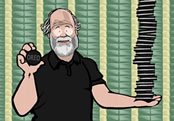
Without the benefit of spin-masters, focus groups, or donors whispering in his ear, Ben Cohen (Ben & Jerry's co-founder) of True Majority has come up with a simple, straightforward way to look at what's going on with our nation's government based on where they actually spend our money.

Let's just say Oreo cookies are a key ingredient.

Check out what our government's spending priorities really are, and have fun doing it. Click here.

Please post and distribute widely.

Her Son Died for Free Speech. Now Both are Dead.

A funny thing happened to Cindy Sheehan on the way to the State of the Union address. While our Imperial Prez was polishing up his opening remarks, opportunistically honoring Coretta Scott King's lifelong fight for civil rights, plans to obliterate Cindy Sheehan's civil rights were being put into effect.

In her own words, here is what really happened:
As most of you have probably heard, I was arrested before the State of the Union address last night.

I am speechless with fury at what happened and with grief over what we have lost in our country.

There have been lies from the police and distortions by the press (shocker). So this is what really happened:

This afternoon at the People's State of the Union Address in DC, where I was joined by Congresspersons Lynn Woolsey and John Conyers, Ann Wright, Malik Rahim and John Cavanagh, Lynn brought me a ticket to the State of the Union address. At that time, I was wearing the shirt that said: 2245 Dead. How many more?

After the PSOTU press conference, I was having second thoughts about going to the SOTU at the Capitol. I didn't feel comfortable going. I knew George Bush would say things that would hurt me and anger me, and I knew that I couldn't disrupt the address because Lynn had given me the ticket, and I didn't want to be disruptive out of respect for her. I, in fact, had given the ticket to John Bruhns, who is in Iraq Veterans Against the War. However, Lynn's office had already called the media, and everyone knew I was going to be there, so I sucked it up and went.

I got the ticket back from John, and I met one of Congresswoman Barbara Lee's staffers in the Longworth Congressional Office building and we went to the Capitol via the underground tunnel. I went through security once, then had to use the rest room and went through security again.

My ticket was in the 5th gallery, front row, fourth seat in. The person who in a few minutes was to arrest me, helped me to my seat.

I had just sat down and I was warm from climbing 3 flights of stairs back up from the bathroom so I unzipped my jacket. I turned to the right to take my left arm out, when the same officer saw my shirt and yelled, "Protester." He then ran over to me, hauled me out of my seat, and roughly (with my hands behind my back) shoved me up the stairs. I said something like "I'm going, do you have to be so rough?" By the way, his name is Mike Weight.

The officer ran with me to the elevators, yelling at everyone to move out of the way. When we got to the elevators, he cuffed me and took me outside to await a squad car. On the way out, someone behind me said, "That's Cindy Sheehan." At which point the officer who arrested me said, "Take these steps slowly." I said, "You didn't care about being careful when you were dragging me up the other steps." He said, "That's because you were protesting." Wow, I got hauled out of the People's House because I was "Protesting."

I was never told that I couldn't wear that shirt into the Congress. I was never asked to take it off or zip my jacket back up. If I had been asked to do any of those things ... I would have, and written about the suppression of my freedom of speech later. I was immediately and roughly (I have the bruises and muscle spasms to prove it) hauled off and arrested for "unlawful conduct."

After I had my personal items inventoried and my fingers printed, a nice Sgt. came in and looked at my shirt and said, "2245, huh? I just got back from there."

I told him that my son died there. That's when the enormity of my loss hit me. I have lost my son. I have lost my First Amendment rights. I have lost the country that I love. Where did America go? I started crying in pain.

What did Casey die for? What did the 2244 other brave young Americans die for? What are tens of thousands of them over there in harm's way for still? For this? I can't even wear a shirt that has the number of troops on it that George Bush and his arrogant and ignorant policies are responsible for killing.

I wore the shirt to make a statement. The press knew I was going to be there, and I thought every once in awhile they would show me, and I would have the shirt on. I did not wear it to be disruptive, or I would have unzipped my jacket during George's speech. If I had any idea what happens to people who wear shirts that make the neocons uncomfortable, that I would be arrested ... maybe I would have, but I didn't.

There have already been many wild stories out there.

I have some lawyers looking into filing a First Amendment lawsuit against the government for what happened tonight. I will file it. It is time to take our freedoms and our country back.

I don't want to live in a country that prohibits any person, whether or not he/she has paid the ultimate price for that country, from wearing, saying, writing, or telephoning any negative statements about the government. That's why I am going to take my freedoms and liberties back. That's why I am not going to let BushCo take anything else away from me ... or you.

I am so appreciative of the couple of hundred of protesters who came to the jail while I was locked up to show their support. We have so much potential for good. There is so much good in so many people.

Four hours and 2 jails after I was arrested, I was let out. Again, I am so upset and sore it is hard to think straight.

Keep up the struggle ... I promise you, I will too.

Here's The Washington Post verion.

Too bad the authors didn't check the facts with anyone other than the police. There were plenty of witnesses to the arrest--where is their eyewitness testimony? One side of a story does not good journalism make.

Here's Lynn Woolsey's statement regarding Cindy Sheehan:

US Representative Lynn Woolsey (D-Petaluma) today issued the following statement regarding Cindy Sheehan's arrest in the gallery of the House of Representatives before the State of the Union address. Mrs. Sheehan was Rep. Lynn Woolsey's guest to the President's State of the Union address.

"Since when is free speech conditional on whether you agree with the President? Cindy Sheehan, who gave her own flesh and blood for this disastrous war, did not violate any rules of the House of Representatives. She merely wore a shirt that highlighted the human cost of the Iraq war and expressed a view different than that of the President. Free speech and the First Amendment exist to protect dissenting statements like Ms. Sheehan's last night."

"Stifling the truth will not blind Americans to the immorality of sending young Americans to die in an unnecessary war, against a nation that posed no threat to our security. The President's speech last night was yet another attempt to distort history, as he suggested - once again - that the 9/11 terrorists came from Iraq. Everyone knows this is not true. We must not be afraid to say that the emperor has no clothes. It's time to bring our troops home."
Related articles: The Unknown Candidate: A Tale of Two T-Shirts

The State of the Union: Rebutting the Bunk

Below are several rebuttles to the State of the Union address delivered yesterday by Karl Rove & Co. via GWB. You are guaranteed to enjoy reading each of them more than you did listening to Bushie.

The State of the Union: A Citizen's Rebuttal
By Sarah Vowel
The New York Times

Lying About the State of the Union
Molly Ivins
Truthdig

Same Old Song
Michael Scherer
t r u t h o u t

Kucinich Blasts Bush's State of the Union
(You can listen to Kucinich blast the president's address here.)
Ear to the Ground - Truthdig

Analysis: The State of the Union is Fretful.
The Associated Press
The Albuquerque Tribune

More Dishonesty from Bush in State of Union
By Matthew Rothschild
The Progressive

State of the Union: The End of Denial?
By Carl Pope
The Huffington Post

Tale of Two Presidents
By Richard Wolf & Holly Bailey
Newsweek

Bush Stretches to Defend Surveillance
Los Angeles Times

More of a Stump Speech than a State of the Union Speech
Hispanic Business

State of the... Did He Really Just Say That?!
Blog: Worst Weather Ever

Arab Reaction to State of the Union
By Christopher Dickey
Newsweek
"Bush’s State of the Union Message confirmed the Arab world’s view of the U.S. president as a caricature who talks about strength and determination while projecting an image of stubbornness and confusion."
A Night of Fear Mongering, Big Time
By Jason Leopold
t r u t h o u t

And, last but not least, for all of you masochists out there...

here is the text of the State of the Union address.

The State of Disbelief


Didn't See It Coming, Again
By Maureen Dowd
The New York Times
The White House should hire an anthropologist.

Corporations have begun hiring anthropologists to help them improve product designs and interpret markets. And clearly, the Bush foreign policy team doesn't understand any of the markets where it is barging around ineptly trying to sell America and democracy.

The brand value of America has been in steady decline. The state of the union is sour but the state of the world is chilling, thanks to a hideously ham-handed Bush foreign policy crew that was once billed as a seasoned "dream team."

The more the White House tries to force-feed democracy to tempestuous parts of the world, the more it discovers that you may be able to spin and scare voters in the U.S., but the Middle East is not so easy to manipulate. W. believes in self-determination only if he's doing the determining. Fundamentalists in America like to vote for Mr. Bush, but elsewhere they're violently opposing him.

It's stunning that nearly four decades after Vietnam, our government could be even more culturally illiterate and pigheaded. The Bushies are more obsessed with snooping on Americans than fathoming how other cultures think and react.

One smart anthropologist reinforcing the idea that "mirroring" — assuming other cultures think like us — doesn't work would be a lot more helpful than all of the discredited intelligence agencies that are costing $30 billion a year to miss everything from the breakup of the Soviet Union to 9/11 to no W.M.D. to Osama's hiding place to the Hamas victory.

Bush officials keep claiming they couldn't have anticipated disasters — from the terrorist attacks to Katrina — even when they got specific warnings beforehand. Busy building up the fake nuclear threat in Iraq, they misplayed the real ones in Iran and North Korea. In London Sunday, Condi Rice admitted that all of our diplomats and spies were caught off guard by the Hamas win. "I've asked why nobody saw it coming," she said. "It does say something about us not having a good enough pulse."

Instead of paying the Lincoln Group millions to plant fake newspaper stories in Iraq, the Bush team might try reading real newspaper stories here. Instead of simply believing any fact that makes him feel self-important, the president might try reading history.

Like many other presidential candidates I've interviewed, W. said he liked Winston Churchill. But if he really had read Churchill, he would at least have understood that the Middle East never turns out the way you expect. Churchill, who called Iraq "an ungrateful volcano," would not have been surprised by the new WorldPublicOpinion.org poll showing that close to half of Iraqis approve of attacks on American forces.

The State of the Union is a non-event. But Bob Woodruff and his cameraman, Doug Vogt, being blown up by a roadside bomb has forced the media to focus on what the Bushies try to hide — all the injured and maimed coming home from Iraq.

Mark Landler's Times piece noted that the ABC journalists came to the hospital in Landstuhl, Germany, "on a military transport plane carrying 31 wounded soldiers — about a normal daily influx for this hospital."

As Denise Grady wrote in The Times, the survival rate in Iraq is higher than in other wars, but the wounds are multiple and awful: "combinations of damaged brains and spinal cords, vision and hearing loss, disfigured faces, burns, amputations, mangled limbs, and psychological ills like depression and post-traumatic stress."

The Oilman in Chief lecturing us last night, after five oblivious years, about being drunk on oil, now that Halliburton and Exxon are swimming in profits — Exxon's revenues were bigger than the gross domestic product of either Saudi Arabia or Indonesia — was rich.

A more honest TV moment was Christiane Amanpour labeling Iraq "a black hole." The "spiraling security disaster," she told Larry King, had robbed Iraqis of hope, "and by any indication whether you take the number of journalists killed or wounded, whether you take the number of American soldiers killed or wounded, whether you take the number of Iraqi soldiers killed and wounded, contractors, people working there, it just gets worse and worse."

But, hey, how could the Bushies have known that occupying a Middle East country — and flipping the balance of power from one sect to another — without enough troops to secure it could go wrong? Who on earth could predict the inevitable?

Photo credit: Maureen Dowd. (Fred R. Conrad/The New York Times)