Showing posts with label John F. Kennedy. Show all posts

Monday, February 04, 2008

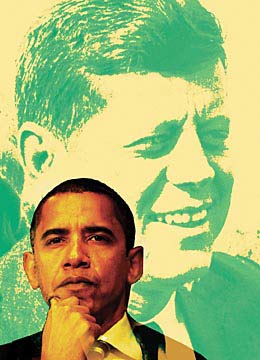
Ask Not What J.F.K. Can Do for Obama


By Frank Rich
The New York Times

BEFORE John F. Kennedy was a president, a legend, a myth and a poltergeist stalking America’s 2008 campaign, he was an upstart contender seen as a risky bet for the Democratic nomination in 1960.

Kennedy was judged “an ambitious but superficial playboy” by his liberal peers, according to his biographer Robert Dallek. “He never said a word of importance in the Senate, and he never did a thing,” in the authoritative estimation of the Senate’s master, Lyndon Johnson. Adlai Stevenson didn’t much like Kennedy, and neither did Harry Truman, who instead supported Senator Stuart Symington of Missouri.

J. F. K. had few policy prescriptions beyond Democratic boilerplate (a higher minimum wage, “comprehensive housing legislation”). As his speechwriter Richard Goodwin recalled in his riveting 1988 memoir “Remembering America,” Kennedy’s main task was to prove his political viability. He had to persuade his party that he was not a wealthy dilettante and not “too young, too inexperienced and, above all, too Catholic” to be president.

How did the fairy-tale prince from Camelot vanquish a field of heavyweights led by the longtime liberal warrior Hubert Humphrey? It wasn’t ideas. It certainly wasn’t experience. It wasn’t even the charisma that Kennedy would show off in that fall’s televised duels with Richard Nixon.

Looking back almost 30 years later, Mr. Goodwin summed it up this way: “He had to touch the secret fears and ambivalent longings of the American heart, divine and speak to the desires of a swiftly changing nation — his message grounded on his own intuition of some vague and spreading desire for national renewal.”

In other words, Kennedy needed two things. He needed poetry, and he needed a country with some desire, however vague, for change....

(Continue Reading)
Photo Credit: WataugaWatch

Sunday, January 27, 2008

The Kennedy's Endorse Obama


A President Like My Father
By Caroline Kennedy
Op-ed Contributer
The New York Times
OVER the years, I’ve been deeply moved by the people who’ve told me they wished they could feel inspired and hopeful about America the way people did when my father was president. This sense is even more profound today. That is why I am supporting a presidential candidate in the Democratic primaries, Barack Obama.

My reasons are patriotic, political and personal, and the three are intertwined. All my life, people have told me that my father changed their lives, that they got involved in public service or politics because he asked them to. And the generation he inspired has passed that spirit on to its children. I meet young people who were born long after John F. Kennedy was president, yet who ask me how to live out his ideals.

Sometimes it takes a while to recognize that someone has a special ability to get us to believe in ourselves, to tie that belief to our highest ideals and imagine that together we can do great things. In those rare moments, when such a person comes along, we need to put aside our plans and reach for what we know is possible.

We have that kind of opportunity with Senator Obama. It isn’t that the other candidates are not experienced or knowledgeable. But this year, that may not be enough. We need a change in the leadership of this country — just as we did in 1960.

Most of us would prefer to base our voting decision on policy differences. However, the candidates’ goals are similar. They have all laid out detailed plans on everything from strengthening our middle class to investing in early childhood education. So qualities of leadership, character and judgment play a larger role than usual.

Senator Obama has demonstrated these qualities throughout his more than two decades of public service, not just in the United States Senate but in Illinois, where he helped turn around struggling communities, taught constitutional law and was an elected state official for eight years. And Senator Obama is showing the same qualities today. He has built a movement that is changing the face of politics in this country, and he has demonstrated a special gift for inspiring young people — known for a willingness to volunteer, but an aversion to politics — to become engaged in the political process.

I have spent the past five years working in the New York City public schools and have three teenage children of my own. There is a generation coming of age that is hopeful, hard-working, innovative and imaginative. But too many of them are also hopeless, defeated and disengaged. As parents, we have a responsibility to help our children to believe in themselves and in their power to shape their future. Senator Obama is inspiring my children, my parents’ grandchildren, with that sense of possibility.

Senator Obama is running a dignified and honest campaign. He has spoken eloquently about the role of faith in his life, and opened a window into his character in two compelling books. And when it comes to judgment, Barack Obama made the right call on the most important issue of our time by opposing the war in Iraq from the beginning.

I want a president who understands that his responsibility is to articulate a vision and encourage others to achieve it; who holds himself, and those around him, to the highest ethical standards; who appeals to the hopes of those who still believe in the American Dream, and those around the world who still believe in the American ideal; and who can lift our spirits, and make us believe again that our country needs every one of us to get involved.

I have never had a president who inspired me the way people tell me that my father inspired them. But for the first time, I believe I have found the man who could be that president — not just for me, but for a new generation of Americans.

Also See:

  • Kennedy to Endorse Obama | New York Times Blog
    Senator Edward M. Kennedy intends to endorse the presidential candidacy of Senator Barack Obama during a rally on Monday in Washington.

    The Kennedy endorsement has been underway for days, even before the outcome of the South Carolina primary. Mr. Kennedy told his decision to Mr. Obama on Thursday.

    “I’ve had ongoing conversations with Ted since I’ve got into this race,” Mr. Obama told reporters today as he flew to Alabama.

    Of all the endorsements in the Democratic Party, Mr. Kennedy’s is viewed as the most weighty. He had vowed to stay out of the presidential nominating fight, but as the contest expands into a state-by-state fight – and given the tone of the race in the last week – associates said he was moved to announce his support for Mr. Obama....
  • The Billary Road to Republican Victory | Frank Rich | New York Times
Photo Credit: President John F. Kennedy with daughter Caroline Kennedy. Medaloffreedom.com

Monday, December 12, 2005

An Exit Strategy For Iraq, Courtesy of JFK

What Would J.F.K. Have Done?
By Theodore C. Sorensen and Arthur Schlesinger Jr.
The New York Times

Sorensen and Schlesinger offer first-hand historical perspective and reveal parallels between the situation Kennedy faced in Vietnam and Bush now faces in Iraq. While Kennedy was never able to put his plan into effect due to his assassination, it makes as much sense for Iraq today as it did for Vietnam then. Unfortunately, Bush, who lacks the wisdom, the intelligence, the compassion and the experience of JFK, will probably never even consider it.

EXCERPTS:
"What did we Americans not hear from President George W. Bush when he spoke...at the U.S. Naval Academy about his strategy for victory in Iraq?

We did not hear that the war in Iraq, already one of the costliest in American history, is a running sore. We did not hear that it has taken more than 2,000 precious American lives and countless - because we do not count them - Iraqi civilian lives.

America can't take that kind of endless and remorseless drain for a vaguely defined military and political mission. If we leave early, the president said, catastrophe might follow. But what of the catastrophe that we are prolonging and worsening by our continued presence, including our continued, unforgivable mistreatment of detainees?

The president says we should support our troops by staying the course; but who is truly willing to support our troops by bringing them safely home?

The responsibility for devising an exit plan rests primarily not with the war's opponents, but with the president who hastily mounted an invasion without enough troops to secure Iraq's borders and arsenals, without enough armor to protect our forces, without enough allied support and without adequate plans for either a secure occupation or a timely exit.
As we listened to Bush's speech, our thoughts raced back four decades to another president, John F. Kennedy. In 1963, the last year of his life, we watched from front-row seats as Kennedy tried to figure out how best to extricate American military advisers and instructors from Vietnam....

...Eventually he began to understand that withdrawal was the viable option. From the spring of 1963 on, he began to articulate the elements of a three-part exit strategy, one that his assassination would prevent him from pursuing. The three components of Kennedy's exit strategy -- well-suited for Iraq after the passage of a new constitution and the coming election -- can be summarized as follows:

Make clear that we're going to get out. At a press conference on Nov. 14, 1963, the president did just that, stating, 'That is our object, to bring Americans home.'

Request an invitation to leave. Arrange for the host government to request the phased withdrawal of all American military personnel -- surely not a difficult step in Iraq, especially after the clan statement last month calling for foreign forces to leave. In a May 1963 press conference, Kennedy declared that if the South Vietnamese government suggested it, 'we would have some troops on their way home' the next day.

Bring the troops home gradually. Initiate a phased American withdrawal over an unannounced period, beginning immediately, while intensifying the training of local security personnel, bearing in mind that with our increased troop mobility and airlift capacity, American forces are available without being stationed in hazardous areas. In September 1963, Kennedy said of the South Vietnamese: 'In the final analysis, it is their war. They are the ones who have to win it or lose it.' A month later, he said, ''It would be our hope to lessen the number of Americans' in Vietnam by the end of the year.

President Kennedy had no guarantee that any of these three components would succeed. In the 'fog of war,' there are no guarantees; but an exit plan without guarantees is better than none at all.

If we leave Iraq at its own government's request, our withdrawal will be neither abandonment nor retreat. Law-abiding Iraqis may face more clan violence, Balkanization and foreign incursions if we leave; but they may face more clan violence, Balkanization and foreign incursions if we stay. The president has said we will not leave Iraq to the terrorists. Let us leave Iraq to the Iraqis, who have survived centuries of civil war, tyranny and attempted foreign domination.

Once American troops are out of Iraq, people around the world will rejoice that we have recovered our senses. What's more, the killing of Americans and the global loss of American credibility will diminish. As Senator Chuck Hagel of Nebraska, a Republican and Vietnam veteran, said, 'The longer we stay, the more problems we're going to have.' Defeatist? The real defeatists are those who say we are stuck there for the next decade of death and destruction.

In a memorandum to President Kennedy, roughly three months after his inauguration, one of us wrote with respect to Vietnam, 'There is no clearer example of a country that cannot be saved unless it saves itself.' Today, Iraq is an even clearer example." Read more.
Photo Credit: John F. Kennedy, photograph in the Oval Office. July 11, 1963. By Cecil Stoughton, White House. (Wikipedia)